
8 Benefits of Design for Excellence (DFX) in New Product Introduction
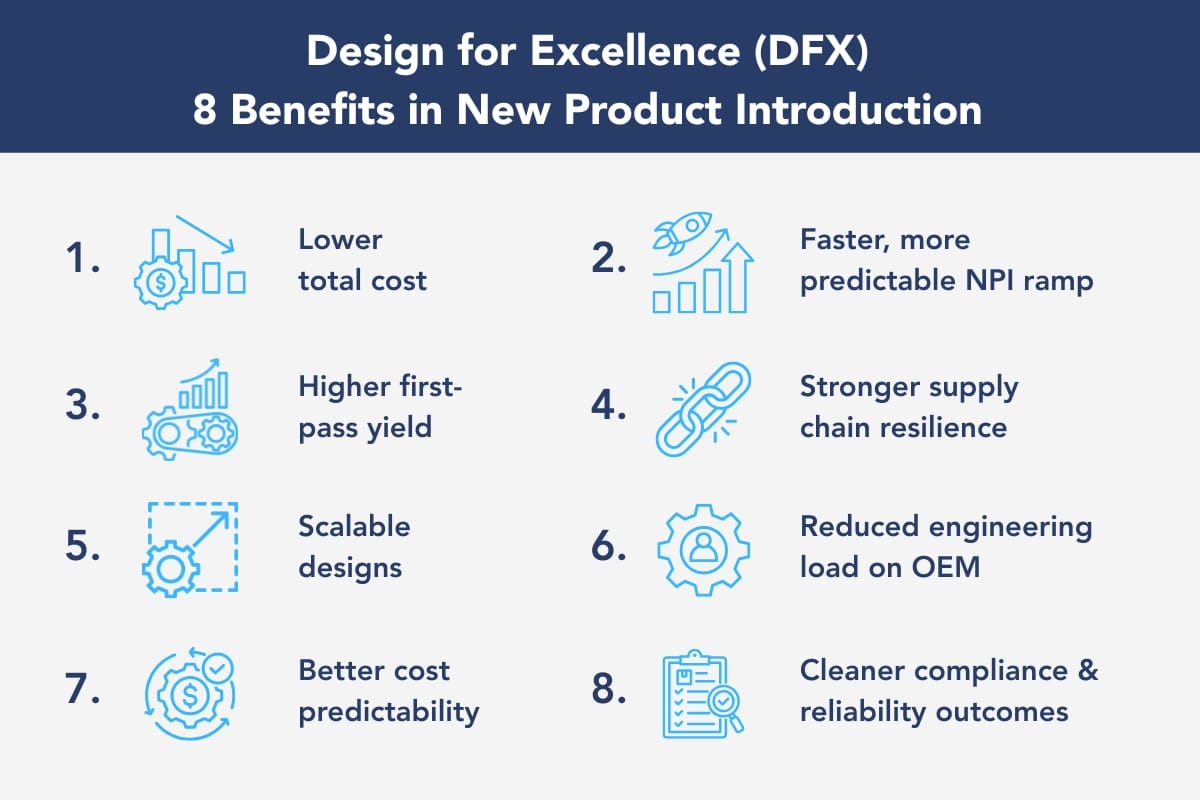
- 1. Lower Total Cost of Ownership (Not Just BOM Cost)
- 2. Faster, More Predictable NPI Ramp
- 3. Higher First-Pass Yield and Product Quality
- 4. Stronger Supply Chain Resilience
- 5. Scalable Designs That Travel Well
- 6. Reduced Engineering Load on the OEM
- 7. Improved Cost Predictability and Forecast Accuracy
- 8. Cleaner Compliance, Reliability, and Certification Outcomes
- Where DFX Has the Highest OEM ROI
- Bottom Line for OEMs
- Partner with Federal Electronics
In today’s electronics manufacturing environment, most cost, schedule, and quality outcomes are decided long before the first production unit is built. By the time a product reaches box build assembly, cable and wire harness assembly or even PCBA manufacturing, the majority of lifetime cost and risk is already locked in.
That is why Design for Excellence (DFX) when deployed early and in partnership with an Electronics Manufacturing Services (EMS) provider, has become one of the most powerful tools OEMs can use to improve New Product Introduction (NPI) outcomes.
DFX is not a late-stage manufacturability check. It is a front-loaded engineering discipline that integrates electronics manufacturing, test, supply chain, and reliability into the design itself, ensuring products are cost-effective, manufacturable, testable, scalable, and robust before they ever reach production. Below is a structured view of what OEMs gain from deploying DFX early in the NPI process, and why it matters.
1. Lower Total Cost of Ownership (Not Just BOM Cost)
Cost is designed into a product, not negotiated on the factory floor. Once a PCB, cable assembly, or enclosure is released to manufacturing, most of its cost structure is already locked in.
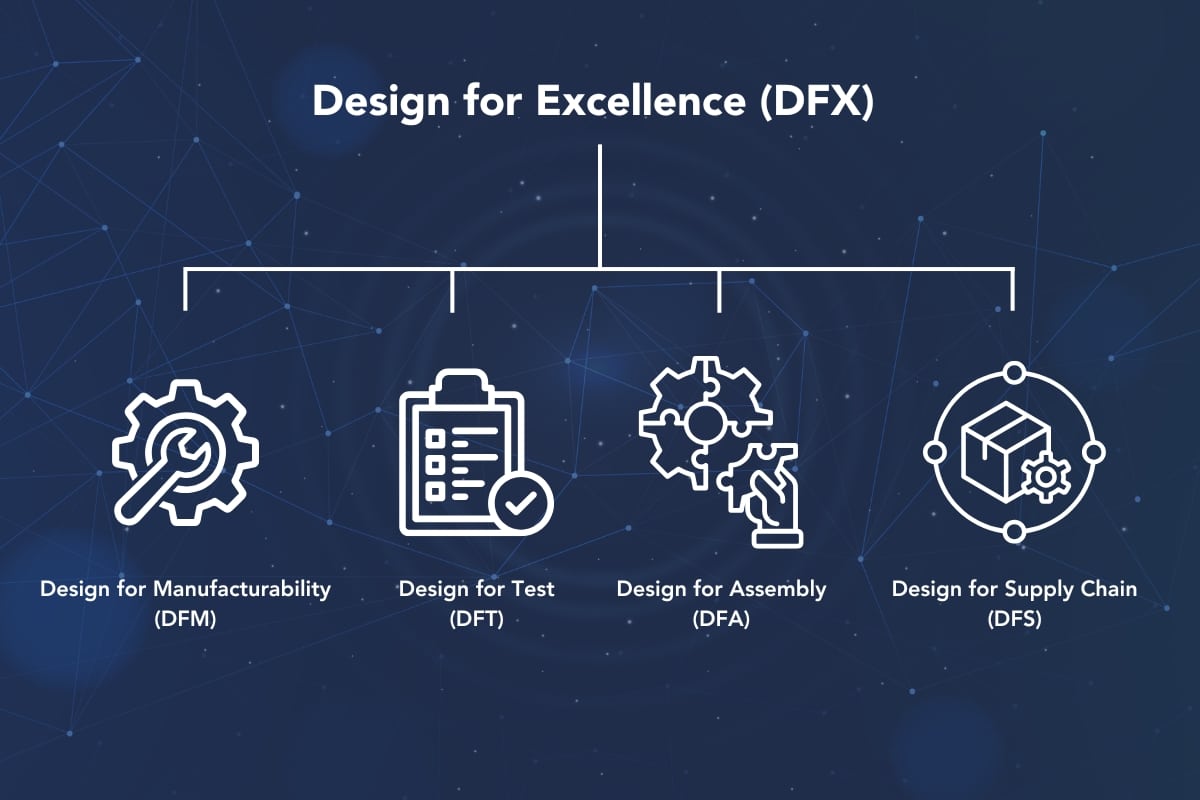
When EMS manufacturing teams lead DFX, they integrate Design for Manufacturability (DFM), Design for Assembly (DFA), Design for Test (DFT), and Design for Supply Chain (DFS) to reduce the true cost of building PCBA, wire harness assembly, and box build systems.
This includes design decisions such as:
- Simplifying PCB stackups and material choices
- Reducing unique fasteners, connectors, and cable types
- Eliminating exotic or hard-to-source electromechanical components
- Optimizing panelization and routings for electronics manufacturing
- Designing assemblies that do not require force, hand-fitting, or rework
Together, these changes reduce both material cost and labor variability, which is where most hidden manufacturing cost lives.
OEMs benefit through:
- BOM reductions via alternates and package optimization
- Lower labor content in box build and harness operations
- Fewer custom fixtures and special EMS processes
This prevents the common trap of a “cheap BOM and expensive build” — where a design looks affordable on paper but becomes costly on the factory floor.
2. Faster, More Predictable NPI Ramp
Many NPI delays occur when designs cannot be built, tested, or supplied as expected once they hit electronic manufacturing.
EMS-led DFX identifies risk early across EMS products by analyzing:
- Test access and pad placement
- Tolerance stack-ups across mechanical and electromechanical parts
- Connector accessibility
- Cable manufacturability
- Component availability
These are the issues that typically cause NPI schedules to slip, not because teams missed them, but because they were never evaluated against real factory conditions.
When these issues are resolved before Engineering Validation Testing (EVT) and Design Validation Testing (DVT):
- Prototype spins are reduced
- Late-stage Engineering Change Orders (ECOs) are avoided
- The transition from prototype to EMS manufacturing is smoother
OEMs gain faster time-to-revenue without increasing execution risk.
3. Higher First-Pass Yield and Product Quality
Yield is not something you fix after launch — it is designed in.
DFX improves yield across all electronics manufacturing services by ensuring details like:
- Reliable solder joints and pad geometry
- Mechanical designs that do not flex or stress PCBs
- Robust connectors and strain relief
- Stable, repeatable electromechanical assembly processes
On the test side, DFX enables:
- Accessible test points on all critical nets
- Boundary scan and built-in self-test
- Simplified fault isolation during electronics manufacturing
OEMs see:
- Higher first-pass yield at launch
- Lower early-life failure rates
- Reduced scrap, rework, and RMAs
4. Stronger Supply Chain Resilience
In modern electronics manufacturing, supply chain risk is no longer something that can be managed after design. It must be engineered into the product from the start.
Through DFX, electronics manufacturing service providers apply real-time component, connector, and lifecycle intelligence to:
- Flag long-lead or Not Recommended for New Design (NRND) components
- Qualify drop-in alternates
- Reduce connector and harness family diversity
- Avoid single-source electromechanical parts
These decisions make designs more adaptable, not just cheaper.
As a result, OEMs can:
- Maintain production during shortages
- Substitute parts without redesign
- Avoid emergency ECO cycles
Instead of reacting to supply disruptions, DFX-enabled designs are built to survive them.
5. Scalable Designs That Travel Well
Very few products stay in one factory for their entire life. Successful products must be able to scale, move, and adapt as demand changes.
DFX ensures designs can travel smoothly across factories and EMS partners by standardizing things like:
- Connector families for wire harness assembly
- Test interfaces for PCBA
- Panelization strategies
- Box build and electromechanical assembly methods
This eliminates fragile, site-specific dependencies that make transfers slow and risky.
It also avoids:
- Custom fixtures that only work in one factory
- Processes that cannot be replicated across electronics manufacturing facilities.
OEMs gain:
- Easier dual-sourcing or regionalization
- Faster capacity scaling
- Lower transfer risk
That flexibility becomes a competitive advantage, not a crisis response.
6. Reduced Engineering Load on the OEM
When electronics manufacturing service providers lead DFX, they absorb much of the manufacturing engineering burden.
EMS teams handle:
- DFM, DFA, and DFT rule checks
- Test strategy and fixture optimization, often in tandem with the OEM
- Panelization and routing efficiency
- Yield and coverage modeling
OEM engineers can focus on:
- Product differentiation
- System architecture
- Innovation
Instead of troubleshooting box build or PCBA failures late in NPI.
7. Improved Cost Predictability and Forecast Accuracy
Accurate cost models require stable, manufacturable designs.
DFX delivers:
- Known routings for PCBA and wire harness assembly
- Predictable yields
- Defined test times
- Clear labor assumptions for electronics manufacturing
When these variables are defined early through DFX, cost models stop being guesses and start reflecting how the product will actually be built.
OEMs benefit from:
- Better “should-cost” models
- More accurate pricing and margin forecasts
- Fewer post-launch surprises
8. Cleaner Compliance, Reliability, and Certification Outcomes
Compliance and reliability are far easier to achieve when designed into electronics early.
DFX supports:
- Regulatory readiness (EMC, safety, and environmental compliance)
- Design reviews that account for known reliability risks in manufacturing and assembly
- Test traceability and documentation for EMS manufacturing audits
OEMs avoid:
- Failed certifications
- Redesigns due to compliance gaps
- Delayed market access
Where DFX Has the Highest OEM ROI
| Product Type | DFX Impact |
|---|---|
| High-mix / low-volume | Very high (labor & yield sensitivity) |
| Complex PCBAs | Very high (test & yield drivers) |
| Regulated products | High (compliance risk) |
| Long lifecycle products | High (obsolescence & cost control) |
| Simple / low-cost products | Moderate |
Bottom Line for OEMs
When electronics manufacturing service providers lead Design for Excellence during New Product Introduction, OEMs gain far more than manufacturable designs — they gain predictable outcomes.
DFX delivers:
Most importantly, DFX shifts risk left — out of the factory and into the design phase, where problems are cheaper, faster, and easier to solve. That is what turns NPI into less of a gamble, and more into a controlled, repeatable process.
Partner with Federal Electronics
Contact us today to learn more about our solutions that are designed to drive your success.