
What is Printed Circuit Board Assembly (PCBA)?
A Guide to PCB Assembly for OEMs
- A Guide to PCB Assembly for OEMs
- What is PCBA (Printed Circuit Board Assembly)?
- The PCBA Process: From Bare Board to Functional Assembly
- PCBA vs PCB: What’s the Difference?
- Why PCBA is Critical for OEMs
- Industries That Rely on High-Quality PCBA
- Benefits of Partnering with a PCBA Manufacturer
- 5 Things OEMs Should Consider When Choosing a PCBA Partner
- Federal Electronics: PCBA Built for Complexity
- The Future of PCBA in Electronics Manufacturing
- Frequently Asked Questions About PCBA
- Partner with Federal Electronics
What is PCBA? When developing electronic products, one of the most critical steps is transforming a bare printed circuit board into a fully functional assembly. This process is known as Printed Circuit Board Assembly (PCBA), often referred to simply as PCB assembly.
For Original Equipment Manufacturers (OEMs), PCBA is more than just placing components on a board—it’s a complex, precision-driven process that directly impacts product performance, reliability, and time to market. Many OEMs partner with electronics manufacturing service (EMS) providers for PCB assembly to ensure their assemblies meet strict quality, compliance, and scalability requirements.
At Federal Electronics, we approach PCBA as a strategic capability—vertically integrated into a broader manufacturing ecosystem that prioritizes supply chain resilience, engineering support, and high-reliability production.
For a broader overview of outsourced electronics manufacturing, see our guide to Electronics Manufacturing Services (EMS).
What is PCBA (Printed Circuit Board Assembly)?
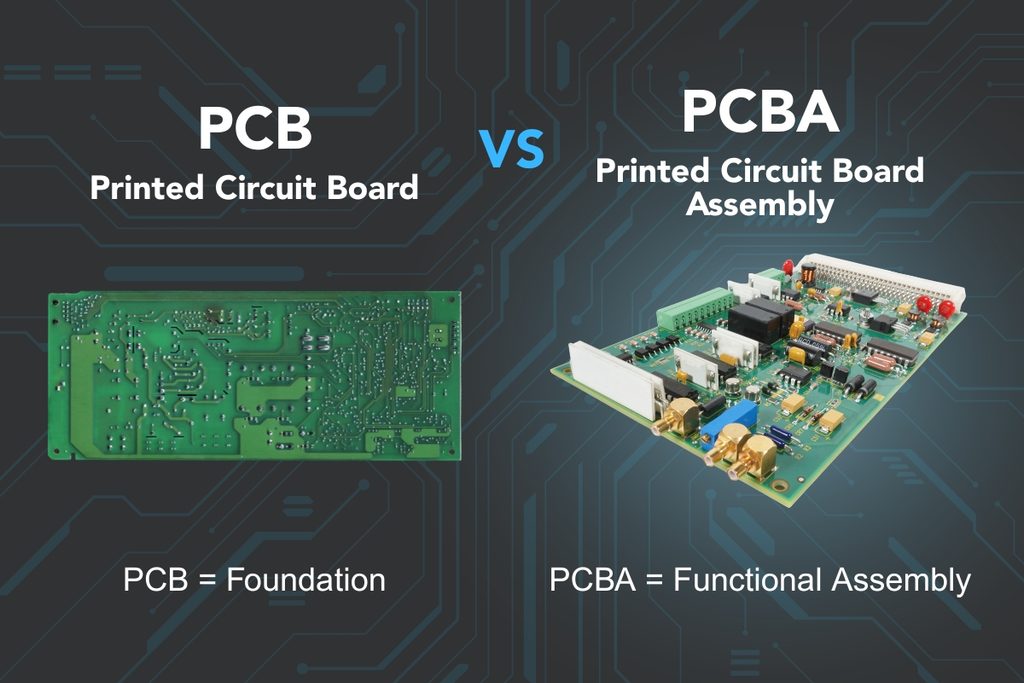
Printed Circuit Board Assembly (PCBA) is the process of mounting and soldering electronic components onto a printed circuit board (PCB) to create a functional electronic assembly.
While a PCB is the bare board with conductive pathways, PCBA refers to the completed board populated with components such as:
- Integrated circuits (ICs)
- Resistors and capacitors
- Connectors
- Diodes and transistors
Once assembled, the PCBA becomes the core of electronic devices used across industries—from aerospace systems to medical equipment and industrial controls.
The PCBA Process: From Bare Board to Functional Assembly
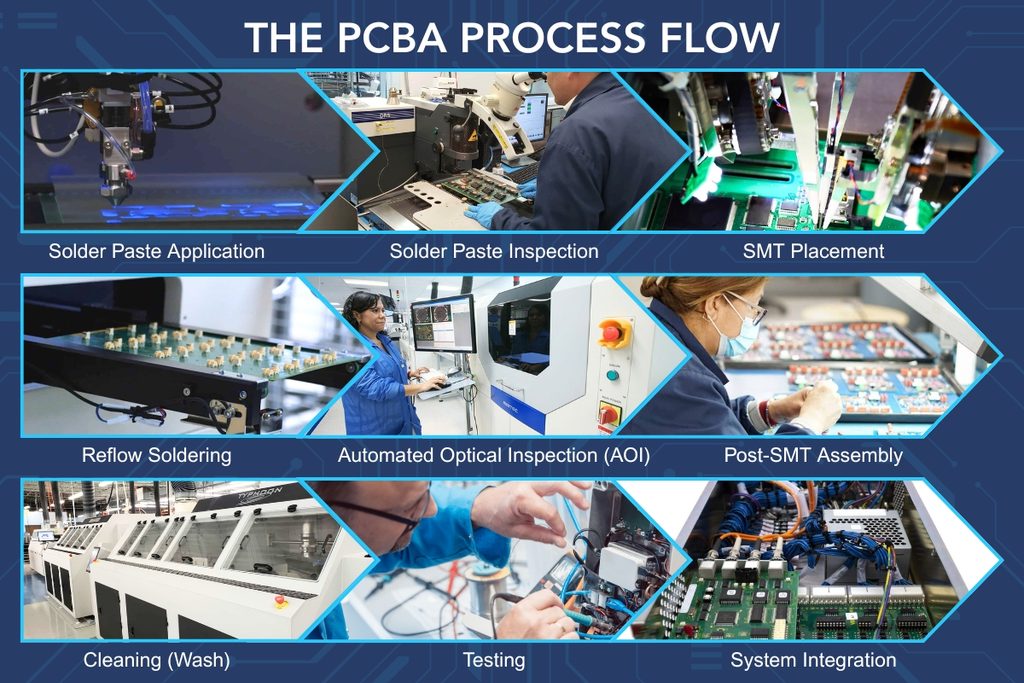
The PCBA process involves several highly controlled steps to ensure accuracy, repeatability, and quality:
1. Solder Paste Application
A stencil is used to apply solder paste to specific areas of the PCB where components will be placed.
2. Solder Paste Inspection (SPI)
Often considered one of the most critical steps in the process, solder paste deposits are inspected to ensure proper volume, alignment, and consistency before component placement.
3. Surface Mount Technology (SMT) Placement
Automated pick-and-place machines position components onto the board with high precision.
4. Reflow Soldering
The board passes through a reflow oven where solder paste melts and forms permanent electrical connections.
5. Automated Optical Inspection (AOI)
High-speed optical systems inspect solder joints and component placement to identify defects such as missing or wrong components, component condition, and solder joint quality.
6. Post-SMT Assembly
Through-Hole, press fit, odd-form and mechanical components are inserted and soldered using wave or selective soldering.
7. Cleaning (Wash)
Boards are cleaned to remove flux residues and contaminants that could impact performance or long-term reliability.
8. Testing
Electrical and functional testing is performed to verify performance and ensure the assembly meets design requirements. This may include in-circuit testing (ICT), flying probe and/or functional testing, or other validation methods.
9. Final Assembly Integration
PCBAs are integrated into higher-level assemblies such as box builds or complete systems.
PCBA vs PCB: What’s the Difference?
Understanding the distinction between PCB and PCBA is essential:
| PCB (Printed Circuit Board) | PCBA (Printed Circuit Board Assembly) |
|---|---|
| Bare board with copper traces | Fully assembled board with components |
| Not functional on its own | Fully functional electronic assembly |
| Manufactured by PCB fabricators | Completed by EMS providers |
In short, PCB is the foundation—PCBA is the finished product.
This distinction is important because OEMs often source PCBs and PCBAs from different suppliers, depending on their manufacturing strategy.
Why PCBA is Critical for OEMs
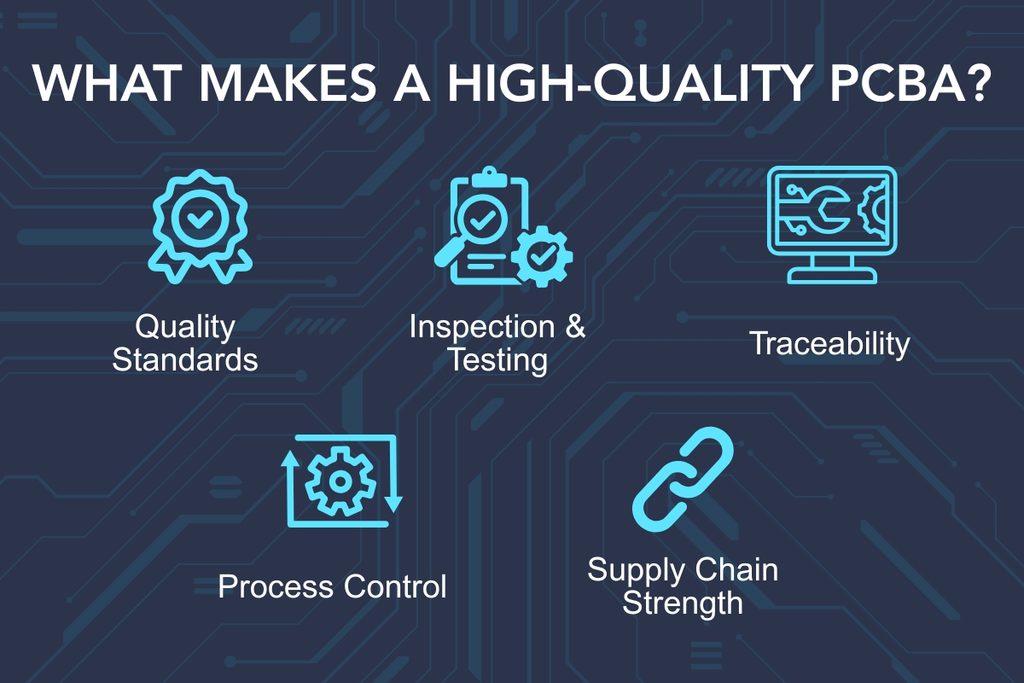
PCBA is not just a manufacturing step—it’s a key driver of product success. For OEMs in high-reliability industries, PCBA quality directly impacts product performance, compliance, and long-term field reliability.
Performance & Reliability
Poor assembly quality can lead to failures in the field, especially in high-reliability industries.
Scalability
A capable PCBA partner ensures smooth transition from prototype to full production.
Supply Chain Stability
Component sourcing and lifecycle management are critical in today’s volatile global environment.
Compliance & Certification
Industries like aerospace and medical require strict adherence to standards such as:
- IPC Class 2 and Class 3
- ISO 9001
- AS9100
Industries That Rely on High-Quality PCBA
Federal Electronics specializes in high-reliability PCBA across key industries:
Aerospace & Defense
Mission-critical PCBAs built to AS9100 and IPC Class 3 standards.
Medical Devices
Precision assemblies with full traceability and regulatory compliance, supported by ISO 13485 quality standards.
Industrial Equipment
Complex, high-mix PCBAs for automation, robotics, and control systems, supported by ISO 9001-certified quality systems.
Semiconductor Capital Equipment
High-performance assemblies supporting advanced manufacturing systems.
Benefits of Partnering with a PCBA Manufacturer
Working with an experienced EMS provider for PCBA offers several advantages:
- Improved Quality & Yield – Advanced inspection and process control
- Faster Time to Market – Streamlined production and New Product Introduction (NPI) support
- Supply Chain Risk Mitigation – Proactive component sourcing and lifecycle management strategies
- Engineering Support – Design-for-manufacturability (DFM) improvements
- Scalability – Seamless transition from prototype to production
5 Things OEMs Should Consider When Choosing a PCBA Partner
1. Manufacturing Capabilities
Can they support your complexity, volume, and technology requirements?
2. Quality Systems & Certifications
Do they meet ISO, AS, and IPC standards required for your industry?
3. Supply Chain Strategy
How do they manage shortages, lead times, and risk?
4. Engineering Support
Can they support your complexity, volume, and technology requirements?
5. Flexibility & Responsiveness
Can they adapt to demand variability and product changes?
Federal Electronics: PCBA Built for Complexity
At Federal Electronics, PCBA is part of a fully integrated manufacturing solution designed for high-reliability OEMs.
Our differentiators include:
- Dual-Site U.S.–Mexico Operations
Providing scalability, redundancy, and proximity to U.S. markets - Supply Chain Risk Mitigation
Proactive strategies to manage component shortages and disruptions - Vertically Integrated Capabilities
PCBA, cable & wire harness, box build assembly and full system integration under one roof—reducing costs and improving control - Built to IPC Class 2 and Class 3 Standards
Ensuring reliability for demanding applications
This integrated approach allows OEMs to reduce supplier complexity while improving visibility, control, and overall manufacturing efficiency.
The Future of PCBA in Electronics Manufacturing
As electronics become more complex and supply chains more volatile, PCBA will continue to play a central role in manufacturing strategy.
Key trends shaping the future include:
- Nearshoring and regional manufacturing (U.S. & Mexico)
- Increased automation and smart manufacturing
- Greater emphasis on supply chain resilience
- Rising demand for complex, lower-volume production
OEMs that treat PCBA as a strategic function—not just a transactional service—will be better positioned to navigate supply chain volatility and increasing product complexity. Success will depend on partnering with PCBA manufacturers who can deliver both technical precision and strategic value.
Frequently Asked Questions About PCBA
What does PCBA stand for?
PCBA stands for Printed Circuit Board Assembly, the process of assembling electronic components onto a PCB.
What is the difference between PCB and PCBA?
A PCB is a bare board, while a PCBA is a fully assembled and functional electronic circuit.
What is included in PCBA services?
PCBA services typically include component sourcing, SMT placement, through-hole assembly, soldering, inspection, and testing.
Looking for a PCBA partner built for high-reliability manufacturing? Explore our PCB Assembly services and Contact Federal Electronics to discuss your next project.
Partner with Federal Electronics
Contact us today to learn more about our solutions that are designed to drive your success.