
Electronics Contract Manufacturing: How the Right Partner Speeds Time-to-Market
- Market Pressures Driving Faster Time-to-Market
- The Role of Electronics Contract Manufacturers in Supply Chain Agility
- Benefits of Partnering with the Right Electronic Contract Manufacturer
- Integrating Engineering and Manufacturing Early
- How Contract Manufacturing Improves Time-to-Market
- Partnering for Growth and Innovation
- Conclusion
- Ready to Choose the Right EMS Partner?
- Partner with Federal Electronics
In today’s competitive electronics landscape, time-to-market defines success. OEMs face mounting pressure to bring products to customers faster—without compromising quality, compliance, or reliability. Supply-chain volatility, component shortages, and increasingly complex regulatory frameworks have made it clear: speed requires strategy.
This is where the right contract manufacturing partner becomes indispensable. A trusted electronics contract manufacturer doesn’t just build your product—they build your momentum. They bridge engineering and supply chain, streamline sourcing, and help OEMs anticipate challenges before they arise.
Market Pressures Driving Faster Time-to-Market
Across industries, product lifecycles are shrinking while customer expectations continue to rise. Complex electronic systems—from medical devices to aerospace subsystems—must now meet tighter launch windows and greater regulatory scrutiny. Meanwhile, globalization and the push toward nearshoring have added new layers of logistical complexity.
To stay competitive, OEMs are rethinking how design, sourcing, and manufacturing work together. The ability to compress development cycles while maintaining high reliability has become a core differentiator—one that relies heavily on strategic partnerships and data-driven production ecosystems.
The Role of Electronics Contract Manufacturers in Supply Chain Agility
Modern electronics contract manufacturing services have evolved far beyond transactional, build-to-print production. Today’s top partners function as extensions of the OEM’s team—integrating with internal systems, optimizing inventory, and managing risk through proactive supply-chain planning.
A skilled contract manufacturer leverages digital tools and real-time visibility to monitor materials, supplier performance, and logistics. This data-driven approach supports rapid decision-making when market conditions shift—allowing OEMs to stay responsive instead of reactive.
A strategic Electronic Contract Manufacturing (ECM) partner can also strengthen supply resilience through:
- Multi-site operations that provide redundancy and flexibility.
- Vendor-managed inventory (VMI) and bonded stock programs that reduce lead time.
- Advanced traceability systems that ensure compliance across the supply chain.
- Collaborative forecasting that aligns material availability with demand fluctuations.
Today, many manufacturers are also embracing predictive analytics, digital twins, and AI-based planning tools to improve supply visibility and simulate production outcomes before costly delays occur. As Deloitte’s 2025 report on enhancing supply chain resilience highlights, manufacturers are rebalancing their strategies toward agility and resilience amid evolving policy and market pressures. Combined with transparent collaboration between OEM and supplier, these tools turn agility into a measurable competitive advantage.
Benefits of Partnering with the Right Electronic Contract Manufacturer
The best electronic contract manufacturing (ECM) providers bring together vertical integration, engineering collaboration, and robust quality systems. They aren’t just producing, they’re problem-solving.
Comprehensive electronic manufacturing services (EMS) unify every step of production, including printed circuit board assembly, cable and wire harness assembly, and full system integration.
Key benefits include:
- Reduced complexity and risk: End-to-end control of materials, compliance, and traceability.
- Scalable capacity: Seamless adjustments for changing product volumes or lifecycles.
- Uncompromising quality: Certified to industry-leading standards including AS9100, ISO 9001, and IPC/J-STD-001 — with additional certifications supporting high-reliability manufacturing across defense, medical, and industrial sectors.
- Standardized processes across locations: Consistency and quality whether production happens in Cranston RI, Hermosillo Mexico, or both.
- Design partnership: Engineering input early in the process ensures products are manufacturable, reliable, and cost-efficient from day one.
This alignment transforms the relationship from a transactional vendor dynamic into a long-term strategic alliance—one that enhances every phase of the product lifecycle.
Integrating Engineering and Manufacturing Early
Bridging design and production is one of the most effective ways to accelerate time to market. When engineering and manufacturing teams collaborate early, potential issues with manufacturability, testability, and component sourcing can be identified before they impact production.
This early integration enables:
- Prototype-to-production continuity: Using consistent materials and processes from pilot runs to full-scale builds
- Optimized component selection: Choosing parts with strong lifecycle availability to prevent future shortages
- Reduced ECO (Engineering Change Order) frequency: Design feedback early in development reduces costly mid-cycle revisions
- Enhanced reliability testing: Early DFM/DFT input ensures smoother transitions from design validation to manufacturing verification
By combining engineering insight with contract manufacturing expertise, OEMs can design smarter, build faster, and avoid the costly rework that delays product launches.
How Contract Manufacturing Improves Time-to-Market
Accelerating product delivery is not just about working faster—it’s about working smarter. A capable contract manufacturer compresses production timelines by integrating into your process early, offering Design for Manufacturability (DFM) and Design for Testability (DFT) feedback before final design lock.
Through collaborative contract manufacturing services, OEMs can:
- Shorten new product introductions (NPIs): Streamlined product launch to production transitions reduce downtime between design and launch.
- Leverage engineering expertise: Insight into process optimization, component selection, and cost-efficient assembly methods.
- Reduce handoffs: Integrated PCBA, cable assembly, wire harness assembly, and box-build processes eliminate delays caused by multiple vendors.
- Mitigate supply risk: Multi-sourcing strategies and nearshoring provide continuity even in constrained markets.
- Achieve faster time-to-market: Consistent quality, optimized workflows, and synchronized communication minimize production bottlenecks.
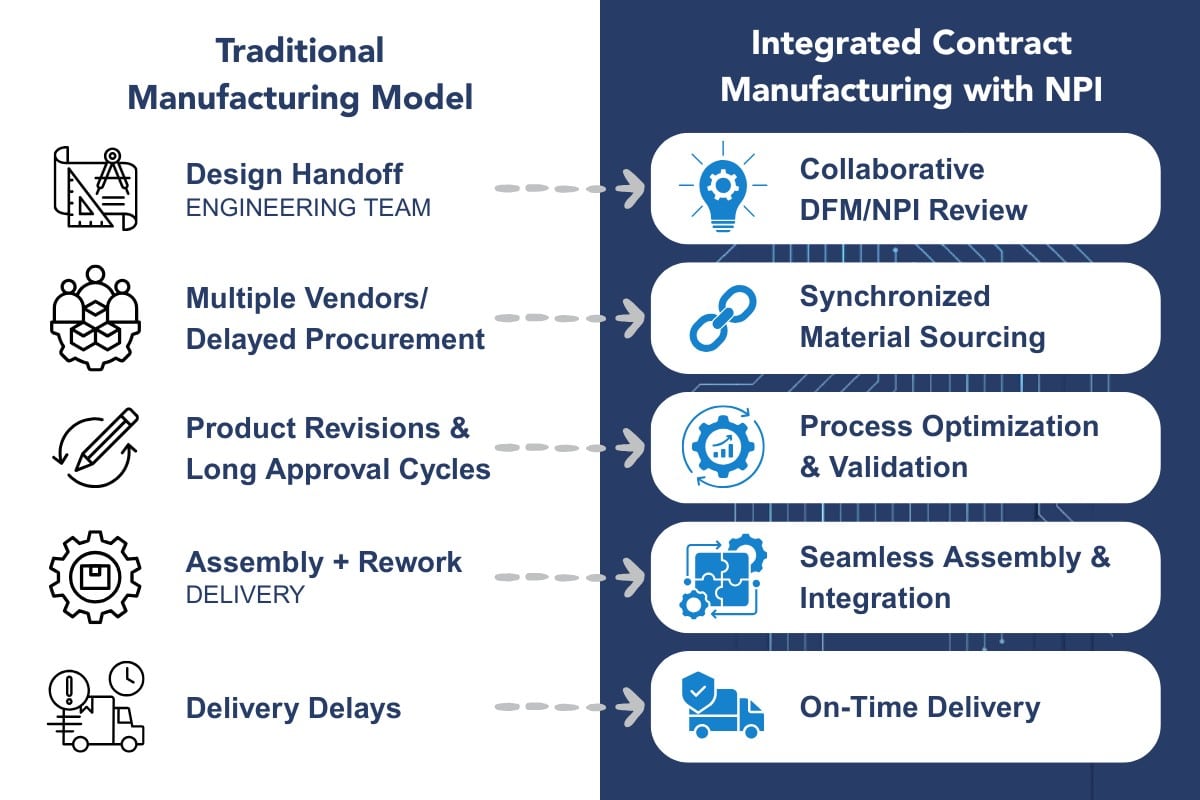
This approach enables OEMs to strategically balance cost, risk, and speed—selecting the best site or partner mix for their program goals and leveraging flexibility across their global operations.
Partnering for Growth and Innovation
Choosing a contract manufacturer isn’t just a tactical decision, it’s a strategic investment in your brand’s agility and longevity. The right partner contributes directly to innovation by freeing OEM teams to focus on R&D, market expansion, and product differentiation.
Effective partnerships are built on:
- Early engineering engagement to identify design efficiencies.
- Transparent communication channels to maintain alignment.
- Predictable cost modeling that supports sustainable scaling.
Modern ECMs are also driving innovation through data-driven traceability, sustainable materials management, and lifecycle support programs that help OEMs extend product relevance while reducing waste. These forward-looking practices not only improve environmental performance but also strengthen brand reputation and long-term competitiveness.
When challenges arise—be it supply-chain disruption, rapid market change, or new compliance requirements—OEMs can pivot with confidence, not compromise.
Conclusion
Selecting the right contract manufacturing partner isn’t just about outsourcing—it’s about accelerating innovation. By working with an experienced electronic contract manufacturer that prioritizes agility, precision, and reliability, OEMs can shorten lead times, strengthen their supply chain, and bring products to market faster.
Ready to Choose the Right EMS Partner?
Selecting the right contract manufacturer is one of the most impactful decisions an OEM can make—and it pays to be informed before you commit.
Download our free whitepaper, “7 Things You Must Know Before Selecting an EMS Partner,” to learn the key criteria for evaluating capabilities, scalability, flexibility, and cultural fit.
You’ll gain insights on:
- Aligning outsourcing strategies with business goals
- Evaluating technical and administrative capabilities
- Measuring total acquisition cost beyond unit price

Partner with Federal Electronics
Contact us today to learn more about our solutions that are designed to drive your success.