
Selecting an Electronics Contract Manufacturer: 7 Critical Factors OEMs Must Consider
- Why Selecting the Right Electronics Contract Manufacturer Matters
- 7 Critical Factors to Evaluate When Selecting an Electronics Contract Manufacturer
- Why OEMs Choose Federal Electronics as Their Electronics Contract Manufacturer and EMS Partner
- Conclusion: Choosing the Right Electronics Contract Manufacturer
- Partner with Federal Electronics
Choosing the right electronics contract manufacturer is one of the most important decisions an OEM can make, directly impacting product quality, supply chain stability, and long-term operational success.
A qualified electronics manufacturing services (EMS) provider does more than assemble printed circuit boards—they serve as a strategic electronics manufacturing partner supporting engineering, quality, and supply chain execution.
The wrong partner can introduce production delays, quality issues, and supply chain risk. The right partner strengthens resilience, improves efficiency, and supports long-term growth.
This guide outlines the seven critical factors every OEM should evaluate when selecting an electronics contract manufacturer.
Why Selecting the Right Electronics Contract Manufacturer Matters
An electronics contract manufacturer plays a central role in ensuring consistent product delivery and protecting your supply chain.
Without a structured evaluation process, OEMs risk:
- Production disruption due to supply chain instability.
- Increased total cost from inefficiencies or poor planning.
- Quality failures that impact end customers.
- Limited scalability as product demand evolves.
A disciplined selection process helps ensure your EMS provider can support your program both today and in the future.
7 Critical Factors to Evaluate When Selecting an Electronics Contract Manufacturer
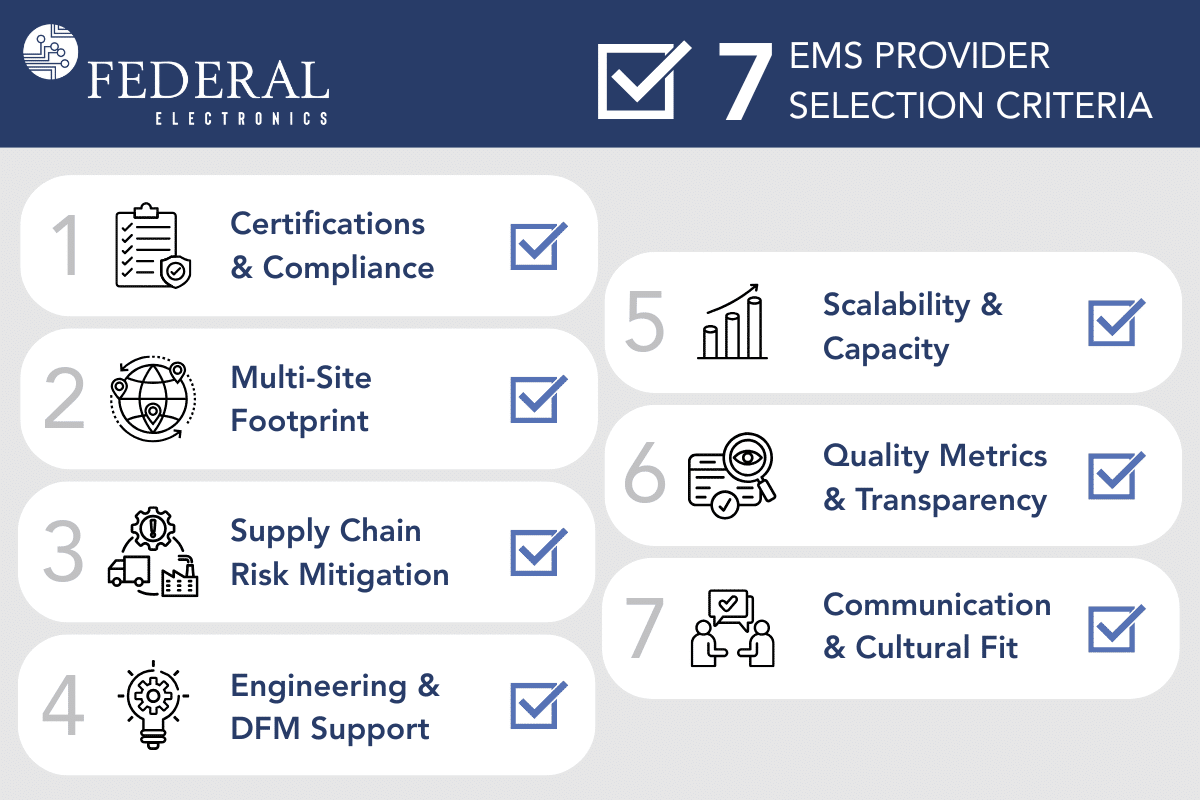
When evaluating EMS providers, focus on these seven critical criteria:
Certifications demonstrate that an electronics contract manufacturer follows established quality and process standards.
Look for:
- ISO 9001 certification as a baseline quality standard
- AS9100 certification for aerospace and defense applications
- ISO 13485 certification for medical device manufacturing
- IPC-A-610, J-STD-001, and IPC/WHMA-A-620 workmanship standards
- ITAR registration and cybersecurity compliance where required
These certifications ensure your electronics manufacturing partner can meet regulatory and reliability requirements.
2. Manufacturing Footprint and Operational Flexibility
A multi-site manufacturing footprint improves flexibility and reduces supply chain risk.
Electronics contract manufacturers with both domestic and nearshore facilities can offer:
- Cost optimization through regional manufacturing
- Business continuity and redundancy
- Greater responsiveness to changing demand
- Reduced logistics complexity compared to offshore sourcing
This flexibility is especially valuable in today’s evolving global supply chain environment.
3. Supply Chain Risk Management Capabilities
Supply chain resilience is a critical capability for any electronics manufacturing partner.
Evaluate whether the EMS provider offers:
- Multi-source component strategies
- BOM risk analysis and obsolescence management
- Strategic inventory programs
- Real-time supply chain intelligence and quoting platforms such as Z2Data and CalcuQuote
Strong supply chain management protects production continuity and reduces disruption risk.
4. Engineering Support and Design for Manufacturability (DFM)
Engineering expertise is essential to ensuring efficient and reliable manufacturing.
A qualified electronics contract manufacturer should provide:
- Design for Manufacturability (DFM) feedback
- New Product Introduction (NPI) support
- Prototyping capabilities
- Manufacturing engineering support throughout the product lifecycle
Early engineering involvement improves yield, reduces cost, and enhances long-term reliability.
5. Scalability and Production Capacity
Your electronics manufacturing partner must be able to scale production as demand evolves.
Key capabilities include:
- Flexible production capacity
- Strong production planning systems
- Ability to support prototype through full production
- Capacity alignment with customer demand forecasts
This ensures your EMS provider can support both current and future requirements.
6. Quality Systems and Performance Transparency
Quality performance is foundational to a successful electronics manufacturing partnership.
Look for EMS providers that offer:
- Robust Quality Management Systems
- Automated inspection capabilities such as AOI and SPI
- Component-level traceability
- Clear quality metrics and reporting
Strong quality systems reduce risk and improve overall product reliability.
7. Communication and Strategic Partnership Alignment
Successful relationships with electronics contract manufacturers are built on communication and trust.
An effective EMS partner provides:
- Transparent communication
- Responsive program management
- Collaborative problem-solving
- Alignment with your operational and business goals
This ensures a productive long-term partnership.
Why OEMs Choose Federal Electronics as Their Electronics Contract Manufacturer and EMS Partner
Federal Electronics provides comprehensive electronics manufacturing services designed to support OEMs across demanding industries.
Our capabilities include:
- Integrated U.S. and Mexico manufacturing operations
- AS9100 and ISO-certified quality systems
- Advanced supply chain risk management
- Engineering-driven manufacturing support
- Expertise supporting industrial, medical, semiconductor, and aerospace OEMs
Our integrated manufacturing model allows OEMs to reduce risk, improve efficiency, and scale production with confidence.
Conclusion: Choosing the Right Electronics Contract Manufacturer
Selecting the right electronics contract manufacturer requires careful evaluation of certifications, engineering capabilities, supply chain expertise, scalability, and communication.
A qualified EMS provider strengthens your supply chain, improves manufacturing efficiency, and supports long-term product success.
By applying these selection criteria, OEMs can identify an electronics manufacturing partner capable of supporting both current production and future growth.
Partner with Federal Electronics
Contact us today to learn more about our solutions that are designed to drive your success.