
2026 Copper Tariffs:
What OEMs Need to Know—and the 3 Ways to Control Cost
- What OEMs Need to Know—and the 3 Ways to Control Cost
- Why The 2026 Copper Tariffs Matter for OEMs
- How to Approach This Decision
- First Determine If Your Product Is Subject to the Tariff
- Option 1: Build in the United States (0% Tariff)
- Option 2: Source U.S.-Origin Copper (~10% Tariff)
- Option 3: Integrate into a Higher-Level Assembly (0% Tariff)
- Choosing the Right Path
- Why Federal Electronics
- The Bottom Line
- Evaluate Your Tariff Exposure
The latest Section 232 tariff updates, effective April 2026, introduce a significant shift in how copper-related imports are treated in the United States.
Previously, these tariffs applied only to the value of the copper component, such as wire and terminals. They now extend to specified copper derivative products, such as cable assemblies and wire harnesses, with duties applied to the full value of the imported article when those products fall within scope. Not all products fall within scope—tariff applicability depends on copper content and classification.
If your product contains electrical wiring—whether it’s industrial equipment, medical devices, control systems, or aerospace assemblies, and your product is manufactured offshore or nearshore—this 2026 copper tariffs change directly affects you.
And under the new structure, that means you may no longer be dealing with a cost increase based on component value—you may now be dealing with tariffs applied to the entire value of your product.
Why The 2026 Copper Tariffs Matter for OEMs
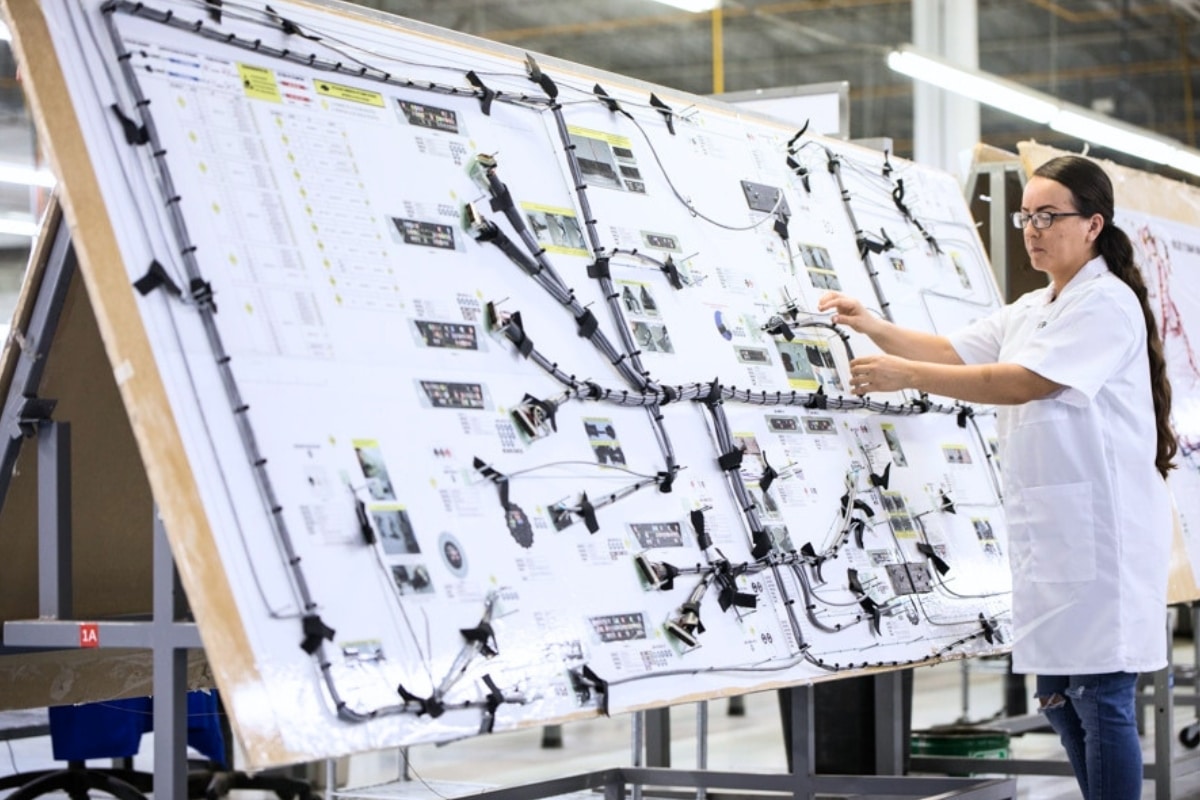
Cable assemblies and wire harnesses are essential to modern equipment. Given the labor intensity of the manufacturing process, they are logical candidates for sourcing in low-cost regions, such as Mexico.
For OEMs, the fact that the tariff applies to the entire value of the product creates immediate pressure on:
- Total landed cost
- Margins
- Overall competitiveness
This isn’t just a sourcing issue—it’s a cost structure issue.
How to Approach This Decision
OEMs are not in a position to redesign products around tariffs—and they shouldn’t be. Your focus is on performance, reliability, and delivering value to your customers.
But under the 2026 copper tariff’s structure, where your product is built and how the components are sourced directly impact cost.
First Determine If Your Product Is Subject to the Tariff
Not all products are affected by the 2026 copper tariffs.
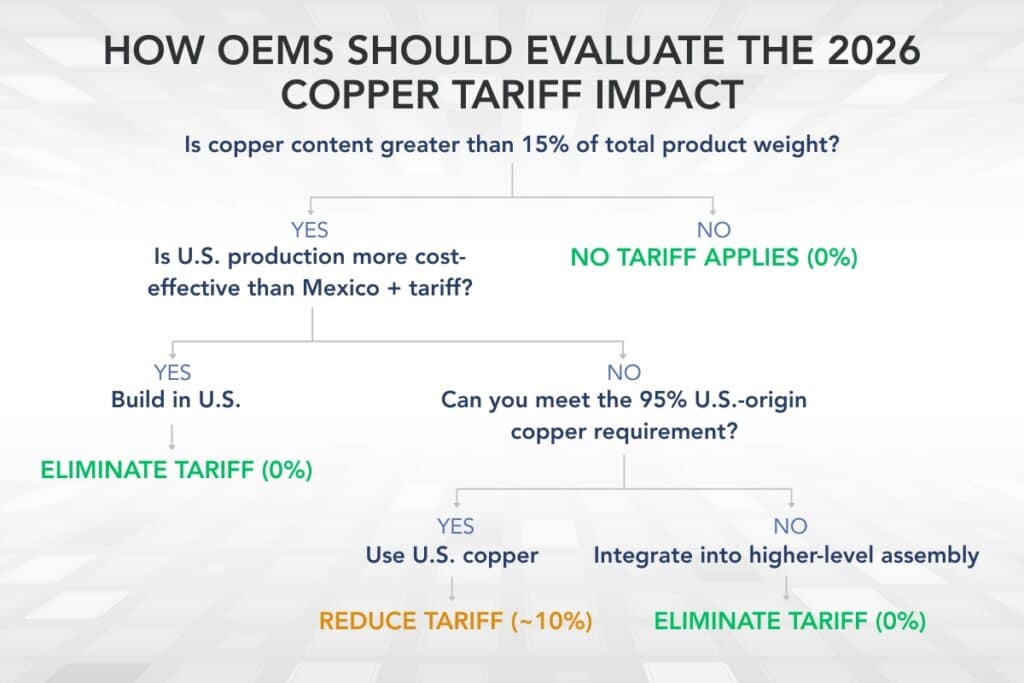
If copper content is 15% or less of total product weight, the product is not subject to copper tariffs.
When this is the case, no additional cost mitigation strategy is required—the tariff does not apply.
When copper content exceeds this threshold, OEMs must evaluate manufacturing location, sourcing strategy, and product structure to minimize tariff impact.
That leaves you with three real options.
Option 1: Build in the United States (0% Tariff)
If your product is built in the U.S., the derivative tariff does not apply to the finished assembly in the same way.
While individual components may still carry tariffs, the full-value tariff on the completed product is eliminated.
When this makes sense:
- When the total cost of producing in the U.S. is lower than the total cost of producing in Mexico + tariff charge
Federal Advantage:
With manufacturing facilities in both the United States and Mexico, Federal Electronics offers the most cost competitive solution based on product configuration and tariff impact.
If tariff policy changes, essentially favoring one region over the other, production can quickly be shifted to the U.S. or Mexico with:
- Existing tooling and fixtures
- Established processes
- An active material pipeline
In many cases, this is a relatively light lift.
Option 2: Source U.S.-Origin Copper (~10% Tariff)

If at least 95% of the copper (by weight) used in your product is smelted in the United States, the tariff can be reduced to approximately 10% of total product value.
When this makes sense:
- When manufacturing in Mexico is still more cost-effective—even with the new tariff
Tradeoff:
- Achieving the 95% threshold can be difficult
In practice, while U.S.-sourced wire may be available, many terminals and connectors are manufactured overseas. These components can account for a significant portion of total weight—often making it difficult to meet the threshold.
Federal Advantage:
Federal works directly within its supply chain to:
- Identify compliant materials
- Validate copper origin
- Evaluate feasibility during quoting
This allows you to pursue this option without redesigning your product or managing supplier complexity internally.
Option 3: Integrate into a Higher-Level Assembly (0% Tariff)
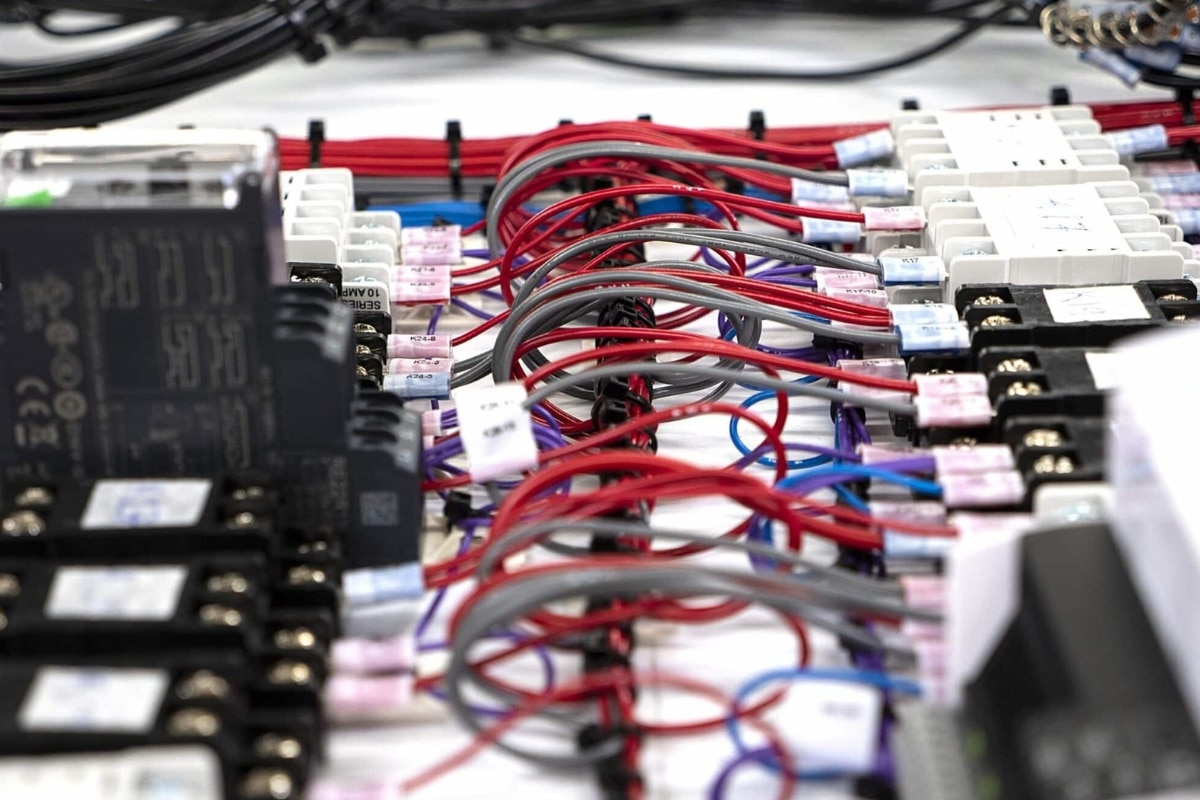
If your cable or wire harness assembly is integrated into a higher-level system—such as a box build, back panel, or electro-mechanical assembly—it may fall under a different HTS classification and move outside the scope of copper derivative tariffs.
When this makes sense:
- When a transformation into a functional product with a different HTS code will provide additional cost benefits while eliminating the tariff
- When the 95% U.S.-copper threshold is not achievable
Tradeoff:
- Requires significant effort, including a commitment to a higher-level outsourcing strategy, quote activity, supplier qualification, etc.
- Implementation can take time to achieve maximum benefit
Federal Advantage:
This is where Federal Electronics is uniquely positioned.
Unlike many cable assembly providers, Federal offers:
- Cable and wire harness assembly
- Printed circuit board assembly (PCBA)
- Box build assembly and electro-mechanical integration
We can:
- Integrate your harness into a higher-level assembly
- Source and fabricate supporting components (including custom sheet metal, enclosures and precision machined parts)
- Deliver a fully integrated and tested system
Different product function. Different import condition. Different cost outcome.
Choosing the Right Path
Each of these options can be the right choice—depending on your product, cost structure, and timeline.
If your product falls below the 15% copper threshold, the most cost-effective path may simply be to maintain your current manufacturing strategy.
- Option 1 is often the simplest to implement
- Option 2 can reduce total tariff cost without changing your build location
- Option 3 can eliminate the tariff entirely while maintaining Mexico’s cost advantages
The key is not choosing a single strategy—it’s working with a partner who can evaluate and execute all three depending upon specific and dynamic circumstances.
Why Federal Electronics
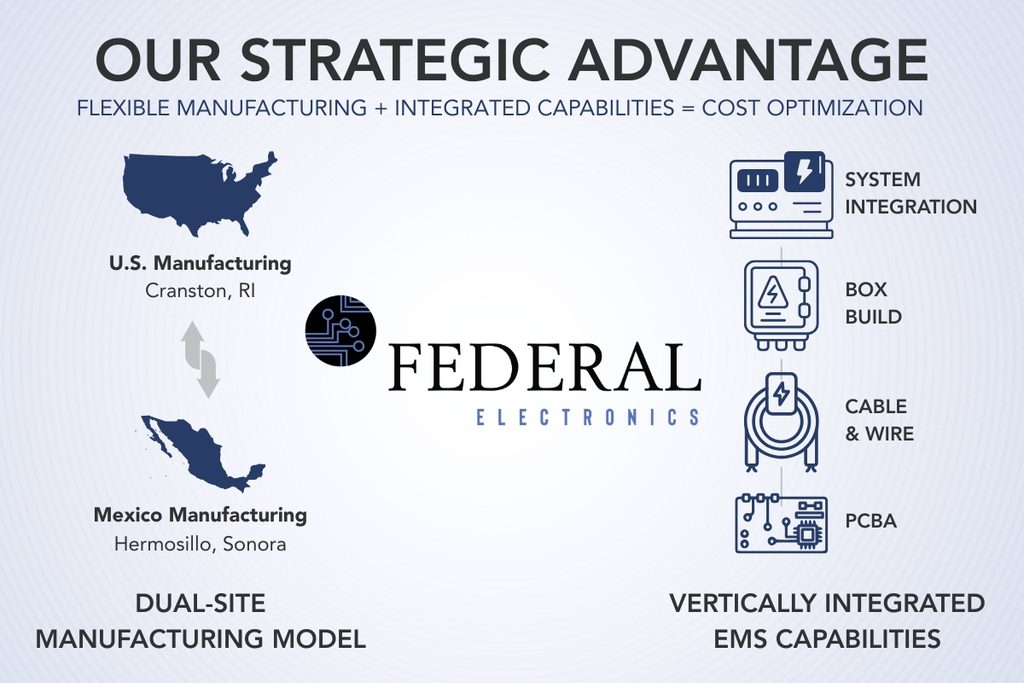
Most suppliers can support one of these paths.
Federal Electronics is built to support all three.
With dual-site manufacturing in the U.S. and Mexico, combined with vertical integration across cable assemblies, PCBAs, and higher-level systems, we help OEMs:
- Adapt quickly to changing tariff conditions
- Optimize total landed cost
- Maintain product integrity and performance
- Build flexibility into their supply chain
The Bottom Line
The 2026 copper tariffs are not just a materials issue—they are a manufacturing and cost strategy issue.
You don’t need to redesign your product.
You need the right partner.
Federal Electronics helps you navigate all three paths—so you can make the decision that’s best for your product, your timeline, and your bottom line.
In a tariff environment where structure and classification drive cost, how your product crosses the border matters just as much as what it is.
Evaluate Your Tariff Exposure
Not sure which path makes the most sense for your program?
We can help you assess total landed cost across U.S. production, sourcing, and integration to identify the most cost-effective approach.