
Why Lower-Volume, Higher-Complexity EMS Manufacturing Requires a Completely Different Skill Set
- The Fundamental Difference: Repetition vs. Variability
- Engineering Becomes Central to Manufacturing
- Workforce Skill Requirements Are Significantly Higher
- Documentation Control Becomes Mission-Critical
- Supply Chain Management Changes Completely
- Quality Systems Must Be More Mature
- Automation Is Still Important — But Used Differently
- What Customers Should Look for When Selecting an EMS Provider
- Evaluating EMS Providers?
- Final Thoughts
- Evaluating a Lower-Volume, Higher-Complexity Program?
The electronics manufacturing services (EMS) industry is often viewed through the lens of high-speed automation, massive production volumes, and globally optimized supply chains. While that model accurately reflects a large segment of consumer electronics manufacturing, it represents only one side of the EMS landscape.
A very different operating model exists for companies serving aerospace, defense, medical, industrial automation, semiconductor equipment, and other mission-critical sectors. These customers frequently require lower-volume, higher-complexity EMS manufacturing — an environment where success is determined less by throughput and more by engineering capability, process discipline, documentation control, configuration management, and organizational agility.
Many OEMs underestimate how dramatically the required EMS skill sets change as manufacturing transitions from high-volume production to complex, lower-volume programs. In reality, the competencies required to build 500 highly engineered assemblies per year are often more demanding than those required to build millions of consumer devices.
Understanding these differences is essential for OEMs selecting an EMS provider. The wrong provider may offer attractive pricing or impressive factory automation but lack the engineering infrastructure, flexibility, and process maturity required to successfully execute complex programs.
The Fundamental Difference: Repetition vs. Variability
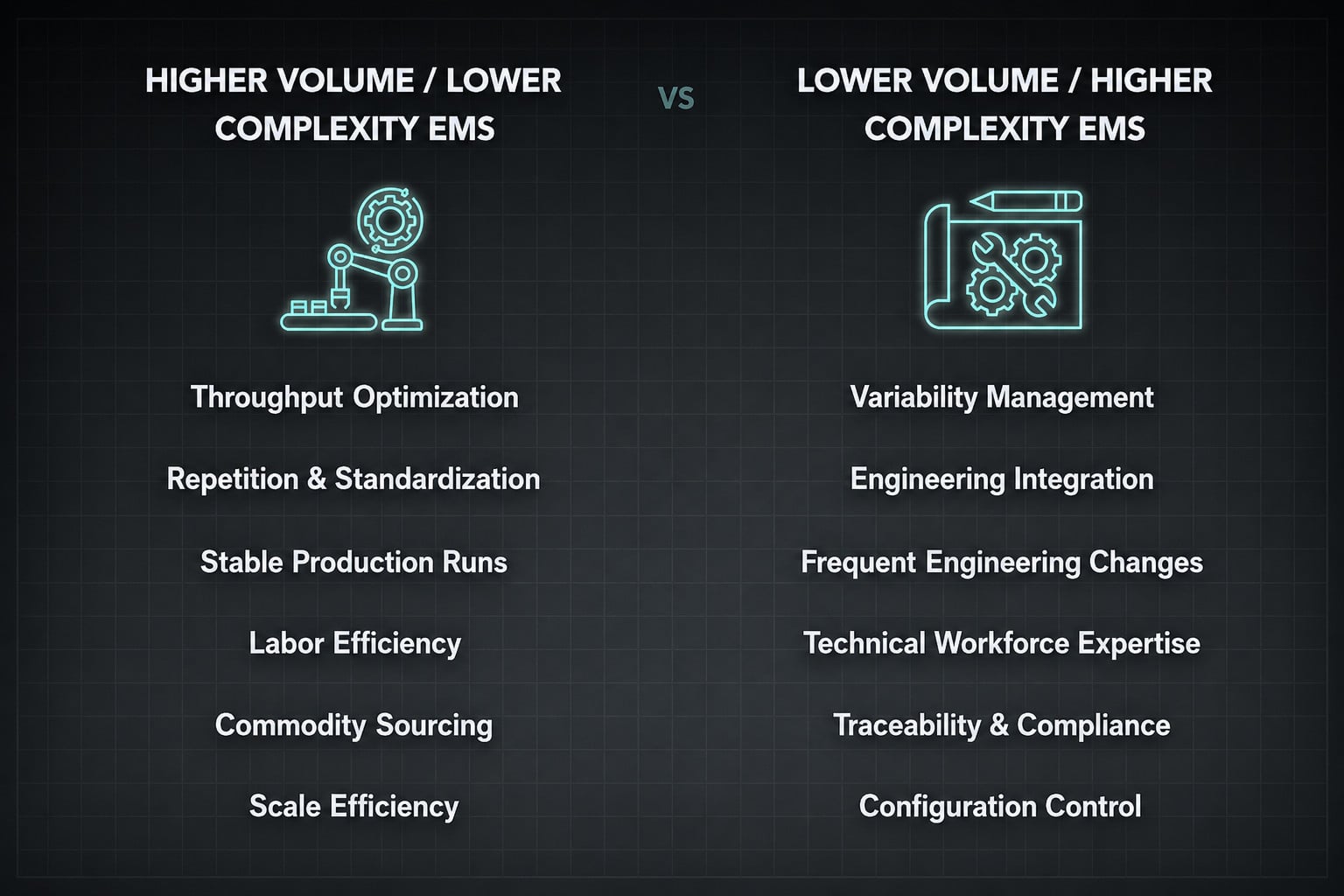
High-volume manufacturing is optimized around repetition. Once a product and process are stabilized, the goal becomes maximizing efficiency, throughput, labor utilization, and material flow consistency.
Success metrics typically include:
- Cycle time reduction
- Overall equipment effectiveness (OEE)
- Labor efficiency
- Machine uptime
- Material velocity
- Cost reduction at scale
- Lean inventory optimization
In contrast, lower-volume, higher-complexity EMS manufacturing is optimized around variability management.
Programs often involve:
- Hundreds or thousands of unique part numbers
- Frequent engineering changes
- Complex bills of material
- Multiple product configurations
- Serialized traceability requirements
- Extensive documentation control
- Regulatory compliance
- High product mix
- Specialized workmanship standards
- Tight customer collaboration
The manufacturing environment becomes less about repeating a stable process and more about controlling complexity without sacrificing quality or schedule performance.
This requires an entirely different organizational DNA.
Engineering Becomes Central to Manufacturing
In high-volume EMS operations, engineering effort is often concentrated during new product introduction (NPI). Once the product stabilizes, manufacturing operations dominate daily execution.
In lower-volume, higher-complexity EMS environments, engineering remains deeply integrated throughout the product lifecycle.
Process engineers must routinely handle:
- Continuous ECO implementation
- Customer drawing interpretation
- Manufacturing risk analysis
- Tooling development
- Custom work instructions
- First article inspection coordination
- Design-for-manufacturability feedback
- Failure analysis
- Process validation
- Configuration management
The EMS provider effectively becomes an extension of the customer’s engineering organization.
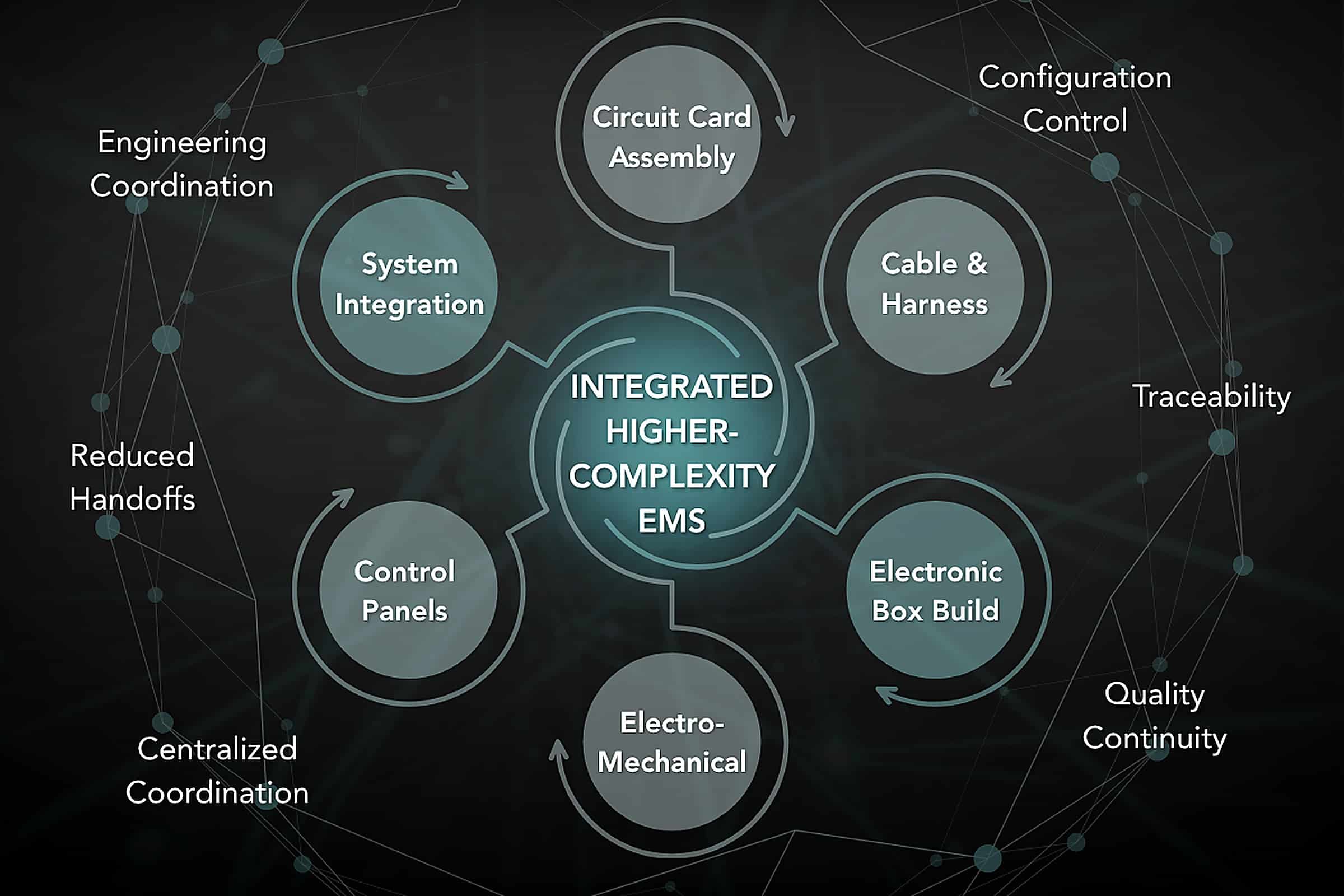
This is especially true in high reliability manufacturing, where documentation packages can include:
- Assembly drawings
- Wiring diagrams
- Wire run lists
- IPC/WHMA-A-610 and -620 workmanship requirements
- AS9100 traceability requirements
- Customer source inspection requirements
- Configuration baselines
- Serialized component controls
- Special process certifications
The provider must possess engineering teams capable not merely of establishing effective and efficient manufacturing processes, but of interpreting and controlling highly technical manufacturing data.
Workforce Skill Requirements Are Significantly Higher
High-volume manufacturing environments are typically designed to reduce operator variability through automation and standardized repetitive tasks.
Lower-volume, higher-complexity EMS manufacturing cannot rely solely on repetition. Operators and technicians frequently encounter new assemblies, new documentation packages, and new build requirements.
As a result, workforce skill requirements increase dramatically.
Operators may need competency in:
- Reading complex assembly drawings
- Interpreting wiring schematics
- Cable and harness routing
- Manual soldering to aerospace standards
- Crimp validation
- Torque verification
- Mechanical assembly integration
- Inspection against IPC Class 3 criteria
- Serialized traceability documentation
Technicians often require even deeper knowledge involving:
- Test system troubleshooting
- Fixture validation
- Root cause analysis
- Process optimization
- Rework to controlled standards
- Failure isolation
- Material substitution control
Unlike high-volume environments where labor specialization is common, lower-volume operations often require multi-skilled personnel capable of adapting across multiple product families.
This creates a much greater dependency on training systems, institutional knowledge, and technical leadership.
Documentation Control Becomes Mission-Critical
One of the biggest operational differences between high-volume and high-complexity EMS manufacturing is the importance of documentation management.
In consumer-oriented high-volume production, products may remain stable for long periods with minimal engineering changes.
In lower-volume complex programs, documentation changes can be constant.
An EMS provider may simultaneously manage:
- Multiple customer revisions
- Deviation approvals
- Temporary process changes
- Redlined drawings
- Alternate component approvals
- Serialized configuration tracking
- Customer-specific workmanship standards
- Controlled software or firmware revisions
The operational challenge is no longer simply “building product.”
It becomes ensuring that every individual assembly is built exactly to the correct revision baseline, using approved materials, approved processes, and approved documentation.
This requires highly disciplined systems for:
- Revision control
- Traveler management
- Electronic document control
- Configuration audits
- Material segregation
- Change implementation verification
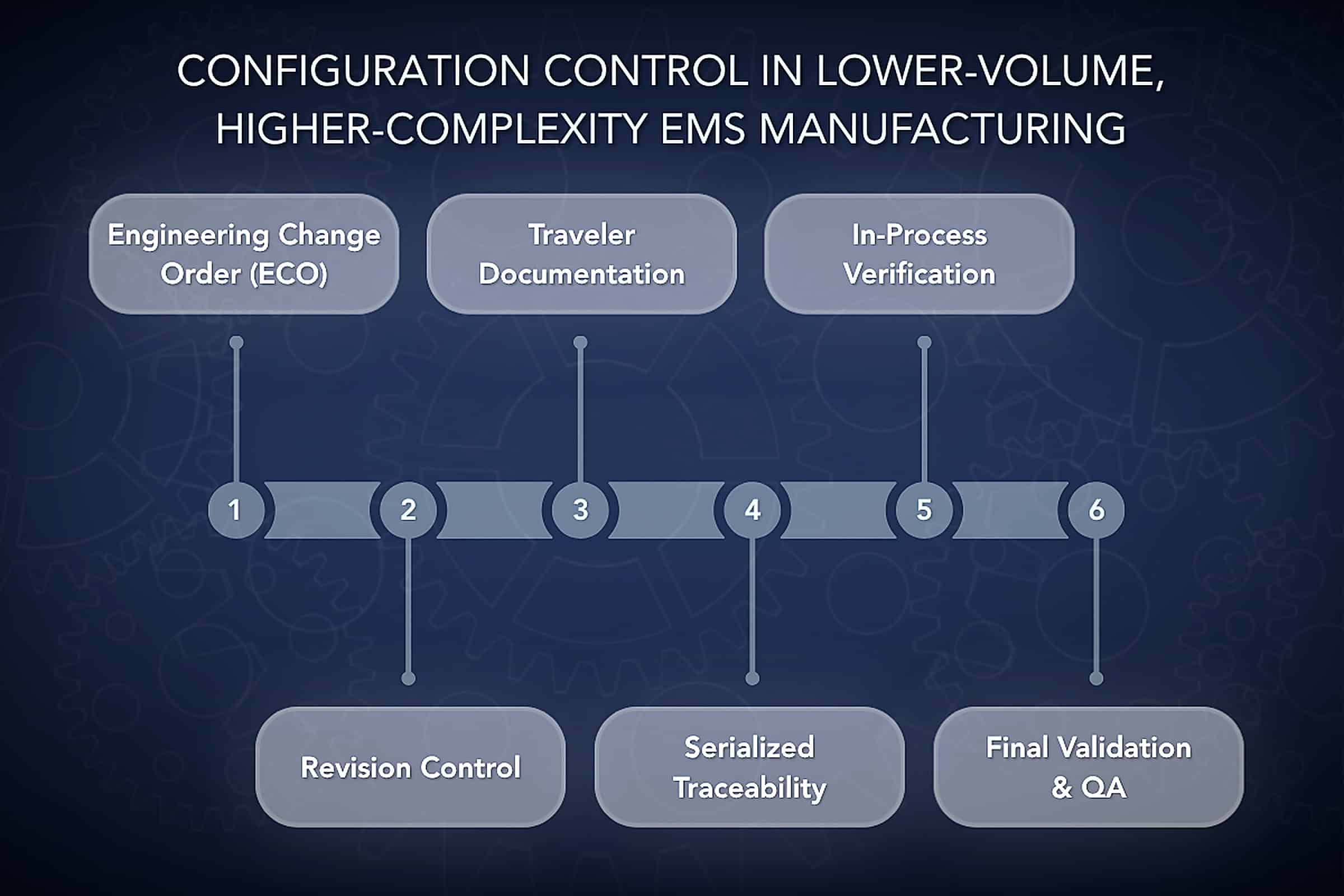
Many EMS providers that excel in high-volume manufacturing struggle in this environment because their systems were designed primarily for throughput optimization rather than configuration control.
Supply Chain Management Changes Completely
Supply chain strategies also differ substantially between the two manufacturing models.
High-volume manufacturing prioritizes:
- Commodity pricing leverage
- Forecast optimization
- Long-term supplier agreements
- Inventory velocity
- Logistics efficiency
Lower-volume, higher-complexity EMS manufacturing prioritizes:
- Material availability
- Obsolescence management
- Traceability
- Authorized sourcing
- Counterfeit prevention
- Long lifecycle support
- Lot control
- Rapid responsiveness to engineering changes
Aerospace and defense programs, in particular, may require:
- Full material certifications
- Country-of-origin restrictions
- ITAR compliance
- DFARS compliance
- Lot traceability
- Shelf-life management
- Approved vendor restrictions
The EMS provider’s procurement organization must therefore possess much stronger technical and compliance-oriented capabilities than would typically be required in commercial high-volume manufacturing.
Quality Systems Must Be More Mature
Lower-volume, higher-complexity EMS manufacturing places extraordinary pressure on quality systems.
In high-volume environments, statistical process control and automated inspection often dominate quality management.
In complex manufacturing environments, many quality risks cannot be fully automated.
The EMS provider must instead rely heavily on:
- Skilled inspectors
- Detailed process controls
- First article inspection systems
- In-process verification
- Training certification programs
- Workmanship validation
- Root cause corrective action systems
- Customer-specific quality requirements
This is particularly important for industries where failure consequences are severe.
An aerospace harness failure, medical device defect, or defense electronics malfunction carries dramatically different implications than a consumer electronics return.
As a result, OEMs should evaluate whether the EMS provider possesses:
- AS9100 certification
- IPC Class 3 capability
- Robust CAPA systems
- Internal audit maturity
- Traceability systems
- Risk management procedures
- Formal process validation methodologies
These systems are often more predictive of success than factory size or equipment count.
Automation Is Still Important — But Used Differently
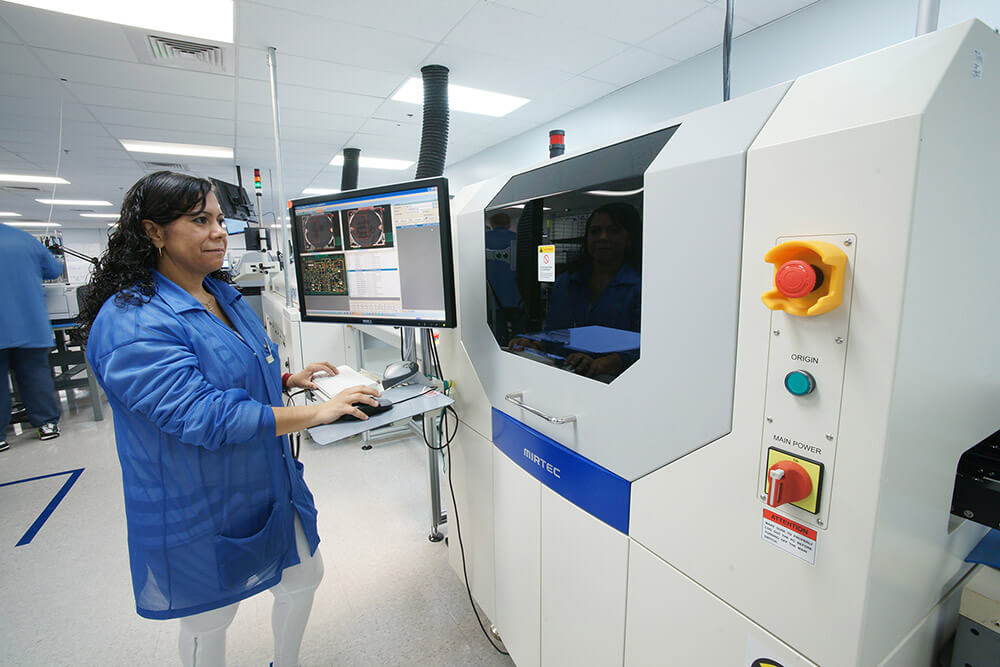
A common misconception is that lower-volume manufacturing is primarily manual.
In reality, advanced automation can still provide enormous value. However, the automation philosophy changes.
High-volume automation is optimized for speed and labor reduction.
Lower-volume automation is optimized for:
- Flexibility
- Setup reduction
- Repeatability
- Error prevention
- Process validation
- Traceability
Examples include:
- Programmable wire processing equipment
- Digital work instruction systems
- Automated test platforms
- MES-driven traceability
- Intelligent tooling
- Vision-assisted inspection
- Flexible SMT platforms
- Quick-change fixturing
The key differentiator is not whether automation exists, but whether the EMS provider knows how to deploy automation in a high-mix environment without sacrificing agility.
What Customers Should Look for When Selecting an EMS Provider
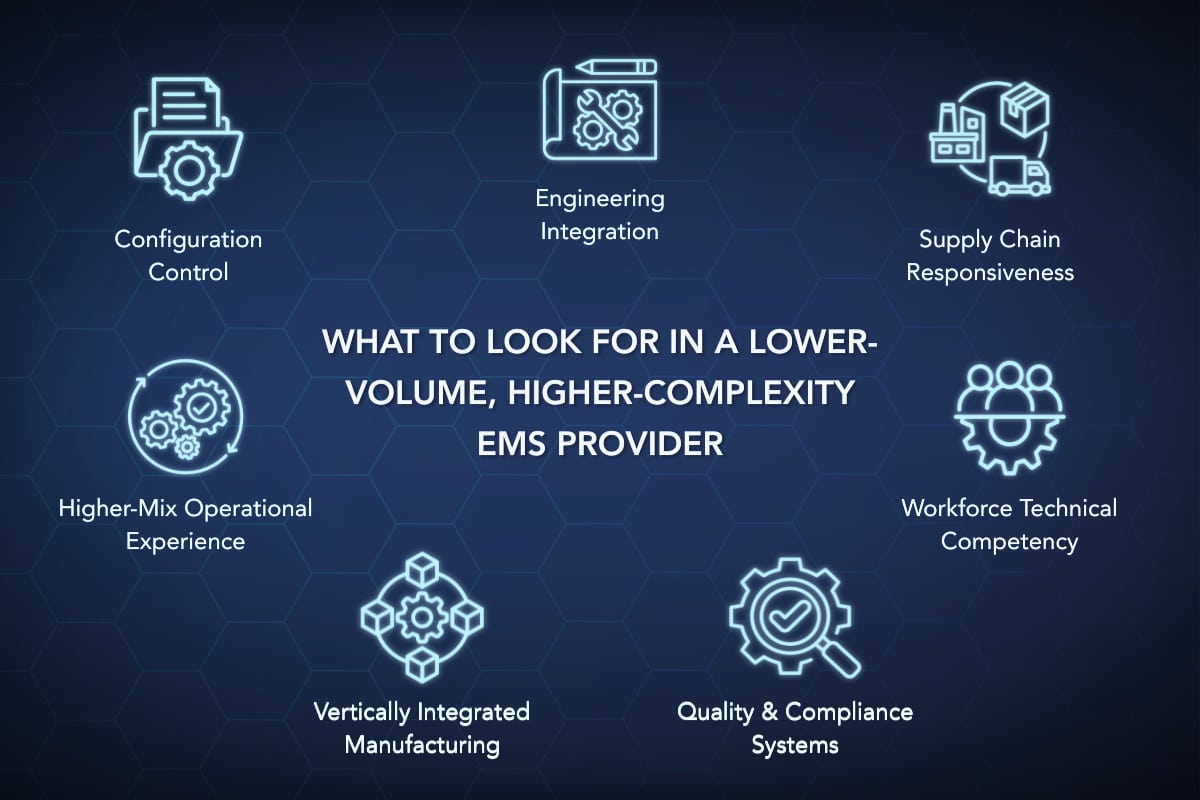
OEMs sourcing lower-volume, higher-complexity manufacturing services should evaluate EMS providers using very different criteria than those commonly used for commodity manufacturing.
Price alone is rarely the best predictor of program success.
Instead, customers should evaluate the following areas carefully.
Engineering Depth
Does the EMS provider possess strong internal engineering capability?
Evaluate:
- Process engineering resources
- Manufacturing engineering depth
- Test engineering capability
- DFM expertise
- Harness/Circuit Card Assembly engineering capability
- NPI infrastructure
Ask how engineering changes are managed during active production.
Configuration Management Discipline
Can the provider reliably control complex revisions and documentation baselines?
Look for:
- Traveler control
- Serialized traceability
- Formal ECO implementation processes
- Configuration audit procedures
Workforce Competency
Ask about:
- IPC certifications
- Training programs
- Cross-training systems
- Employee retention
- Technical apprenticeship programs
Complex manufacturing is highly dependent on workforce quality.
Industry-Specific Certifications
For aerospace and defense programs, evaluate:
- AS9100 certification
- ITAR registration
- CMMC readiness
- IPC/WHMA-A-610 and -620 capability
- J-STD-001 compliance
- Counterfeit material prevention programs
Supply Chain Sophistication
Assess whether procurement teams understand:
- Long lifecycle components
- Obsolescence mitigation
- Authorized sourcing
- Traceability requirements
- Material compliance
Responsiveness and Collaboration
Lower-volume complex manufacturing requires close collaboration between OEM and EMS provider.
Assess:
- Communication quality
- Program management maturity
- Responsiveness to technical questions
- Transparency during problem resolution
- Willingness to provide DFM feedback
The best EMS providers operate as collaborative manufacturing partners, not simply contract assemblers.
Evaluating EMS Providers?
For a broader look at EMS supplier evaluation, read our guide:
“Selecting an Electronics Contract Manufacturer: 7 Critical Factors OEMs Must Consider.”
Explore additional considerations related to engineering support, quality systems, supply chain management, and long-term manufacturing partnership strategy.
Final Thoughts
The EMS industry contains fundamentally different business models operating under the same label.
High-volume manufacturing rewards scale, repetition, and efficiency.
Lower-volume, higher-complexity manufacturing rewards engineering depth, technical agility, process discipline, workforce expertise, and configuration control.
OEMs operating in aerospace, defense, medical, industrial, and other mission-critical sectors should recognize that selecting an EMS provider for complex programs requires evaluating an entirely different set of competencies than those used for commodity production.
The providers best suited for these environments are not always the largest factories or the lowest-cost suppliers.
They are the organizations capable of consistently managing complexity without losing control of quality, documentation, traceability, or customer responsiveness.
In lower-volume, higher-complexity EMS manufacturing, operational excellence is not defined by how fast a factory runs.
It is defined by how precisely it executes.
Evaluating a Lower-Volume, Higher-Complexity Program?
Not every EMS provider is structured for higher-mix, engineering-driven manufacturing.
We can help you assess the operational, engineering, and supply chain considerations behind your program requirements.