
BUILDING A BETTER EMS PROGRAM
The EMS Partner Selection Mistake That Quietly Drives Total Cost HIGHER
Part 1 of 4
- BUILDING A BETTER EMS PROGRAM
- Part 1 of 4
- The Costs That Aren't on the Quote
- OEM Resources Have a Cost
- Complexity Amplifies Small Weaknesses
- Integration Has Economic Value
- Engineering Change Is Where Supplier Differences Become Visible
- Supply-Chain Performance Changes the Equation Too
- Quality Cost Is Mostly the Cost of What Happens Next
- Lowest Total Cost Is Usually a System Outcome
- The Selection Mistake Often Starts Before Supplier Selection
- Next in the Series
- Need Help Evaluating an EMS Partner?
When an OEM evaluates electronics manufacturing services providers, the process almost inevitably ends up in a spreadsheet.
Material cost. Labor. Overhead. NRE. Tooling. Freight. Payment terms.
The quotations are normalized, differences are identified, negotiations take place, and eventually someone asks the question everyone expects:
Who has the lowest price?
There is nothing wrong with that question.
The mistake is assuming it is the same as asking:
Who will have the lowest cost?
For complex electronics manufacturing programs, those can be two very different answers.
One lesson becomes increasingly clear as product complexity increases:
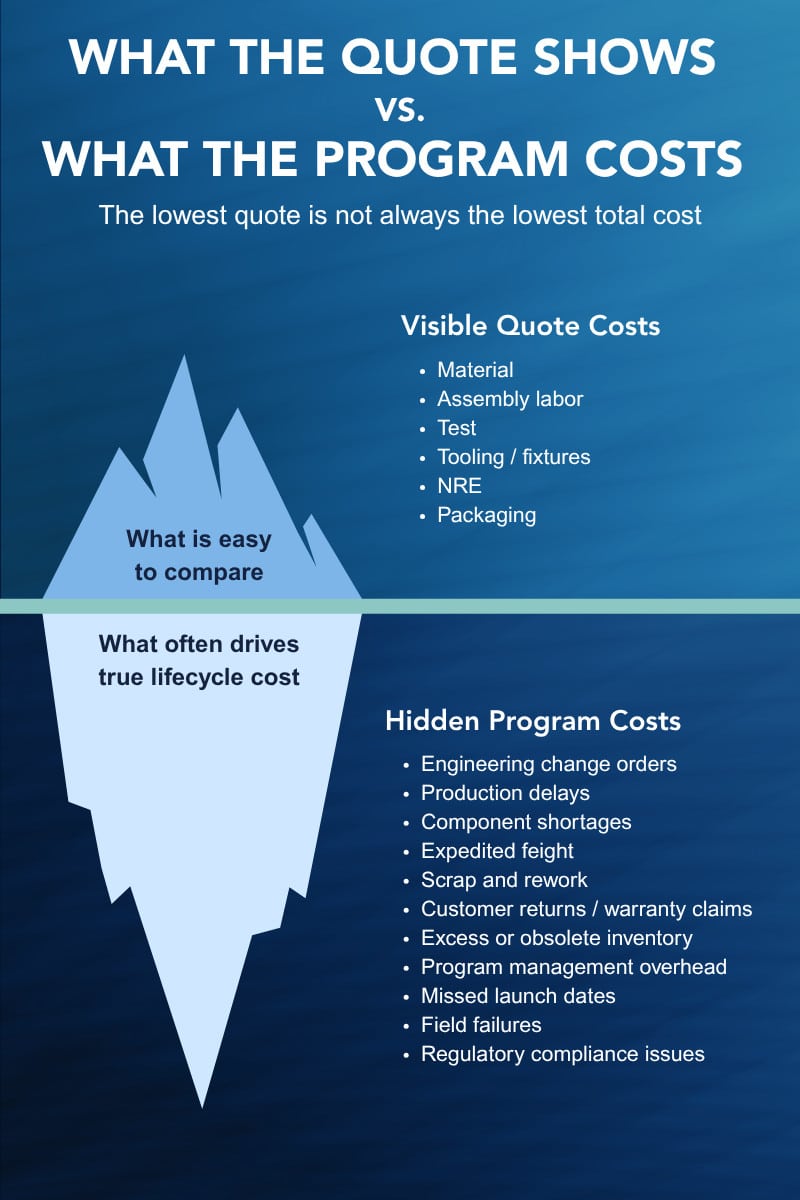
The manufacturing price visible on an RFQ is only part of the economic equation.
The costs that ultimately determine whether an outsourcing decision was successful often show up later.
The Costs That Aren’t on the Quote
Consider two EMS suppliers competing for a program.
Supplier A is 5% less expensive.
Supplier B costs slightly more but has stronger engineering support, more disciplined program management, better supply-chain visibility and the ability to manufacture several elements of the product under one operating system.
Supplier A wins because the savings are easy to quantify.
Six months later, the OEM engineering team is resolving manufacturing questions every week. Purchasing is chasing component shortages. Quality is managing recurring corrective actions. Program management is holding recovery meetings. Cable assemblies are arriving late from another supplier, preventing final system integration.
The original savings still exist on the purchase order.
They just no longer exist in the business.
This is the distinction between purchase price and total program cost.
OEM Resources Have a Cost
One of the most overlooked expenses in outsourced manufacturing is the amount of OEM organizational energy required to manage the supplier.
What happens when a manufacturing partner requires constant intervention?
An engineer spends five hours resolving an assembly problem.
A buyer spends half a day escalating a shortage.
A quality engineer investigates another defect.
A program manager conducts multiple recovery meetings.
An operations executive becomes involved because customer shipments are threatened.
None of those hours appear on the EMS invoice.
They are still costs.
And they are often being consumed by people whose primary responsibility should be designing the next product, managing customers or improving the OEM’s own business.
A useful question when comparing suppliers is therefore:
How much of our organization will this supplier require us to manage?
The answer can materially change the economics.
Complexity Amplifies Small Weaknesses
This becomes especially important as manufacturing complexity increases.
A simple PCBA with a stable design and predictable demand may be relatively straightforward to outsource.
Now add:
- several PCBAs,
- custom cable assemblies,
- wire harnesses,
- machined or fabricated parts,
- electromechanical assembly,
- programmed devices,
- system-level functional testing,
- configuration-controlled documentation,
- serialization and traceability,
- changing forecasts,
- engineering revisions,
- customer-specific quality requirements,
- and regulatory or defense requirements.
The OEM is no longer purchasing an assembly.
It is purchasing a manufacturing ecosystem.
Weakness in one part of that ecosystem can affect everything downstream.
A late cable assembly can stop box build.
A long-lead electronic component can prevent a complete system from shipping.
An ECO implemented incorrectly on one subassembly can make otherwise acceptable material unusable.
A test fixture that is not ready can leave completed product sitting at the end of the manufacturing line.
That is why evaluating an EMS provider solely by unit price becomes increasingly dangerous as program complexity rises.
Integration Has Economic Value
OEM sourcing strategies sometimes optimize each assembly independently.
PCBA Supplier A has the best circuit-board pricing.
Supplier B specializes in harnesses.
Supplier C handles mechanical integration.
The OEM manages final assembly or moves material among suppliers.
That model can absolutely work.
But the interfaces have a cost.
Every supplier boundary creates another forecast, another purchase order, another schedule, another quality interface, another logistics step and another organization that must respond when something changes.
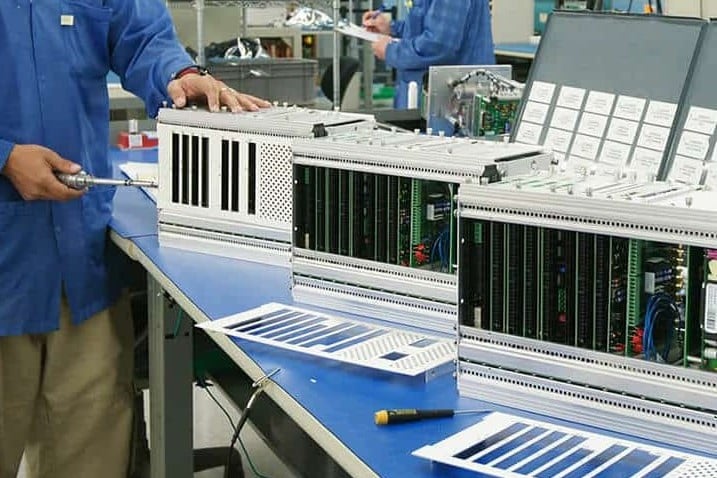
For the right program, vertically integrating PCBAs, cable and wire harnesses, electromechanical assembly and final integration within one EMS organization can eliminate some of those interfaces.
That does not automatically make the integrated supplier cheaper.
It can, however, make the program less expensive.
The important distinction is that the OEM should evaluate the complete operating model rather than assuming that the lowest price for each individual assembly creates the lowest system-level cost.
Engineering Change Is Where Supplier Differences Become Visible
OEM products rarely remain frozen.
Components become obsolete.
Customers request changes.
Design improvements are introduced.
Drawings are updated.
Firmware changes.
Alternate components are approved.
Those changes must propagate through purchasing, inventory, planning, work instructions, programming, inspection, test and production.
In a disciplined EMS environment, an engineering change is not simply a new drawing.
It is a controlled manufacturing event.
When change management is weak, an OEM can end up paying for:
- obsolete inventory,
- rework,
- incorrect revisions,
- line downtime,
- duplicate material,
- missed deliveries,
- and quality escapes.
Again, none of those costs were apparent when the original RFQ was awarded.
Supply-Chain Performance Changes the Equation Too
Material frequently represents the largest portion of an electronics assembly’s cost, but material availability can be even more important than material price.
A component that costs four cents less is not a bargain if it is unavailable when production needs it.
The real capability of an EMS supply-chain organization becomes visible when conditions are imperfect:
- A component goes on allocation.
- A manufacturer announces end-of-life.
- Lead times suddenly extend.
- Forecast demand changes.
- An alternate source needs approval.
- A customer requires traceability or approved-country sourcing.
- A program needs material expedited without creating excess inventory six months later.
The quality of those decisions affects working capital, delivery performance and ultimately customer satisfaction.
Quality Cost Is Mostly the Cost of What Happens Next
OEMs naturally review supplier quality history.
But defect rates alone do not tell the entire story.
The more revealing question is often:
What happens when a defect occurs?
Does the supplier contain the issue immediately?
Can it identify affected serial numbers or lots?
Does engineering participate in root cause?
Is corrective action permanent?
Are work instructions changed?
Does the supplier verify effectiveness?
Does the same problem return three months later?
A strong quality system reduces more than scrap.
It reduces disruption.
That has economic value.
Lowest Total Cost Is Usually a System Outcome
None of this is an argument against aggressive pricing.
OEMs should expect their manufacturing partners to be competitive.
Material pricing should be challenged.
Labor assumptions should be understood.
NRE should be justified.
Productivity improvements should be pursued throughout the life of the program.
But the mature sourcing question is broader:
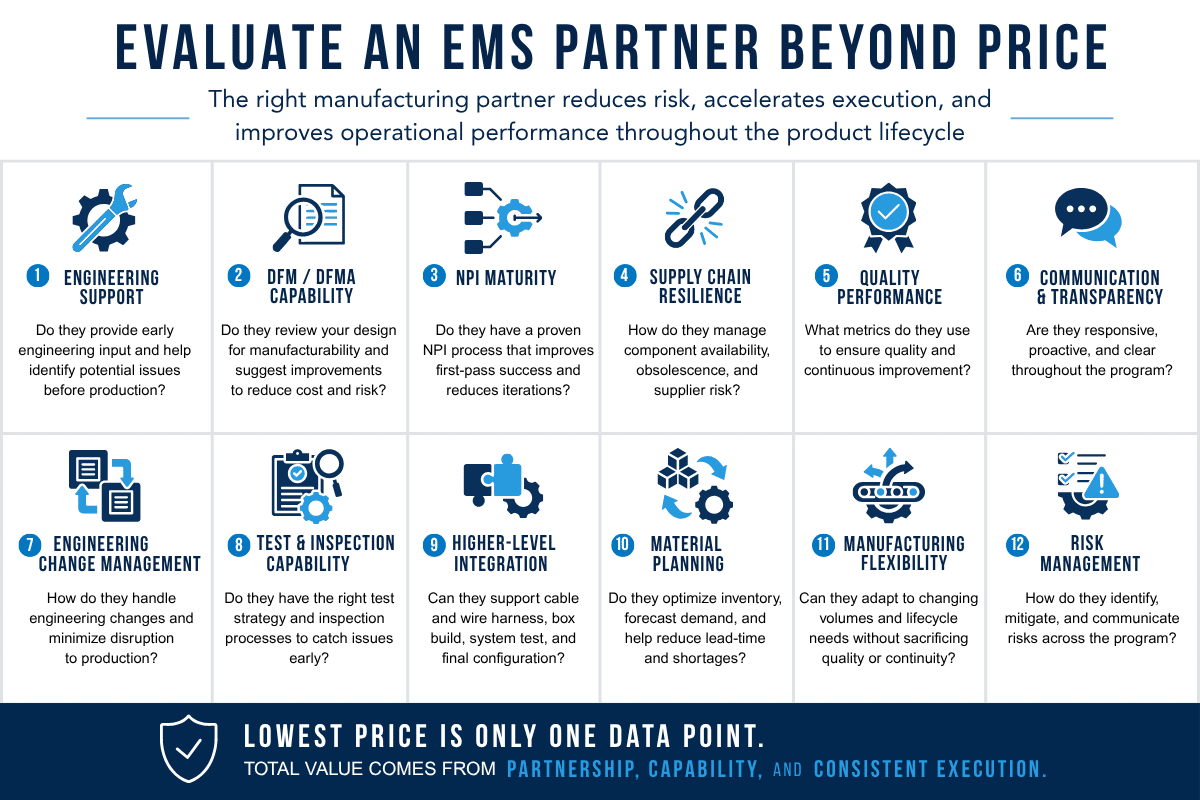
Which supplier gives us the best combination of economics, capability, execution and risk over the life of the program?
For a complex product, that decision may involve evaluating:
- manufacturing capability,
- engineering depth,
- quality systems,
- supply-chain management,
- test capability,
- configuration control,
- program management,
- responsiveness,
- geographic strategy,
- financial stability,
- production flexibility,
- and the OEM resources required to manage the relationship.
The lowest quoted supplier may still win.
But now the OEM knows why.
The Selection Mistake Often Starts Before Supplier Selection
There is one more uncomfortable reality.
Sometimes an OEM selects the wrong EMS partner because it evaluated the suppliers incorrectly.
But sometimes the sourcing process was already compromised before suppliers ever saw the RFQ.
An incomplete BOM, immature drawings, poorly defined test requirements, unrealistic schedules or unclear production assumptions force suppliers to make their own interpretations.
When that happens, the OEM may believe it is comparing four quotations.
In reality, it is comparing four different assumptions about what the program actually requires.
And that leads directly to Part 2.
Next in the Series
Part 2: The Work OEMs Should Do Before Sending an EMS RFQ
Before asking EMS providers for their best answers, OEMs need to make sure they are asking the right questions—and giving every supplier enough information to answer the same question.
Need Help Evaluating an EMS Partner?
If you’re comparing manufacturing partners, we’d be happy to discuss your program, review your manufacturing requirements, and help you identify the factors that have the greatest impact on long-term cost, quality, and delivery performance.