
What CMMC, ITAR, and ISO Certifications Really Mean When Evaluating an EMS Provider
- Why Compliance Matters in Electronics Manufacturing
- Understanding CMMC
- Understanding ITAR
- Understanding ISO Certifications
- How Compliance Supports High-Reliability Manufacturing
- What OEMs Should Look for Beyond the Certification
- Looking Beyond Compliance?
- Evaluating the Complete EMS Partnership
- Need Help Navigating CMMC, ITAR, or ISO Requirements?
Selecting an Electronics Manufacturing Services (EMS) partner is about far more than manufacturing capacity, pricing, or lead times. For OEMs operating in aerospace, defense, medical, industrial automation, semiconductor equipment, and other regulated industries, supplier selection increasingly hinges on compliance, security, quality systems, and risk management.
As a result, certifications and compliance frameworks such as Cybersecurity Maturity Model Certification (CMMC), International Traffic in Arms Regulations (ITAR), and ISO standards often appear prominently in EMS provider marketing materials. However, many OEMs struggle to determine what these certifications actually mean, how they affect manufacturing performance, and which qualifications should carry the most weight during supplier evaluation.
The reality is that certifications alone do not guarantee manufacturing excellence. However, they do provide important evidence that an EMS provider has implemented structured processes, documented controls, and continuous improvement systems that support secure, repeatable, and high-reliability manufacturing operations.
Understanding the role of these frameworks can help OEMs identify suppliers capable of meeting the demanding requirements of regulated industries while reducing operational, quality, cybersecurity, and compliance risks.
Why Compliance Matters in Electronics Manufacturing

Modern electronics manufacturing environments handle far more than component placement and assembly.
EMS providers often manage:
- Customer intellectual property
- Product design data
- Manufacturing process documentation
- Controlled technical information
- Supply chain management
- Product traceability records
- Test procedures and results
- Regulatory documentation
For aerospace, defense, medical, and industrial customers, a failure in any of these areas can create significant consequences, including production delays, cybersecurity vulnerabilities, regulatory violations, product recalls, or mission-critical failures in the field.
Compliance frameworks help establish the management systems and operational controls needed to reduce these risks while creating consistency across manufacturing operations.
Rather than viewing certifications as administrative requirements, OEMs should recognize them as indicators of organizational maturity and operational discipline.
Understanding CMMC
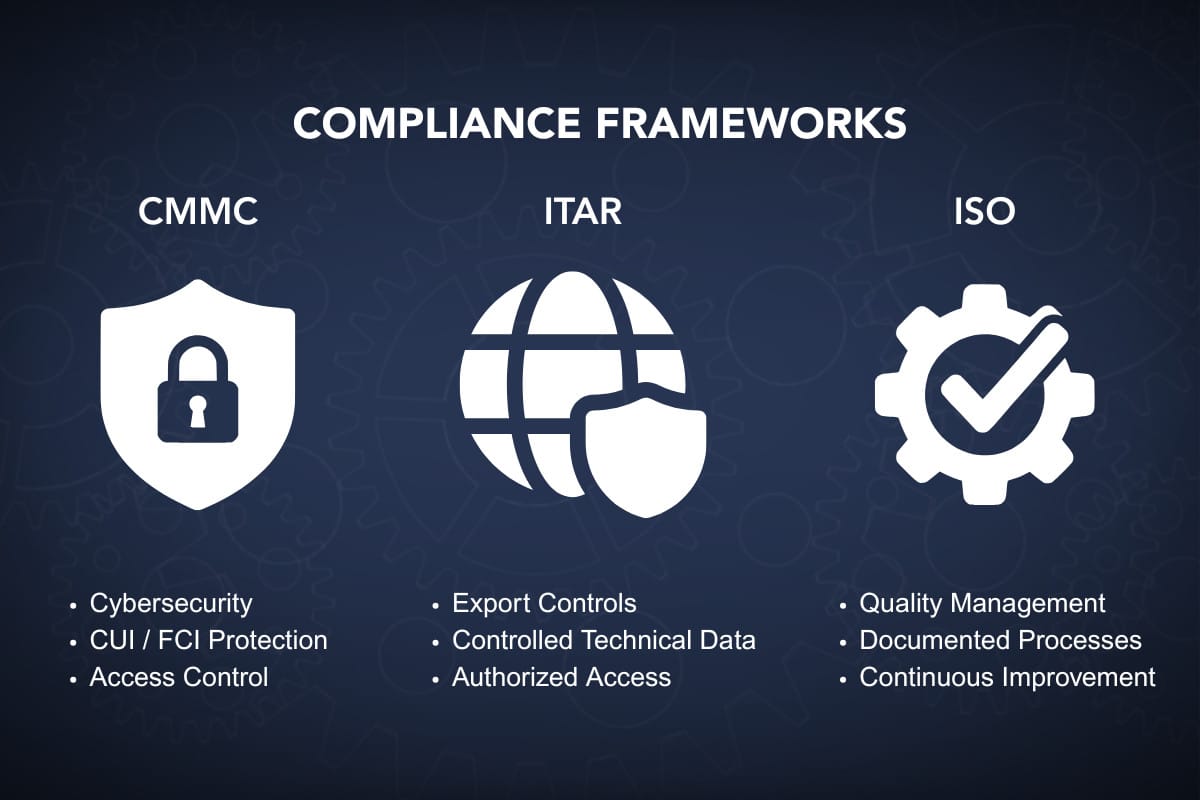
The Cybersecurity Maturity Model Certification (CMMC) framework was developed by the U.S. Department of Defense to strengthen cybersecurity throughout the Defense Industrial Base (DIB).
Its primary objective is to ensure contractors and suppliers adequately protect Controlled Unclassified Information (CUI) and Federal Contract Information (FCI).
For defense contractors and their supply chains, cybersecurity is no longer limited to IT departments. Manufacturing partners increasingly store engineering drawings, bills of material, process documentation, test records, and other sensitive data that may be targeted by cyber threats.
A CMMC-compliant EMS provider demonstrates that cybersecurity controls have been formally implemented and assessed against defined standards.
Areas typically addressed include:
- Access control
- User authentication
- Data protection
- Incident response
- Configuration management
- Security monitoring
- Risk management
- System maintenance
- Personnel security
- Audit logging
From an OEM perspective, CMMC compliance helps reduce the risk that sensitive technical information could be compromised through a supplier’s systems.
This is particularly important for defense programs involving:
- Weapons systems
- Aerospace electronics
- Communications equipment
- Secure computing platforms
- Military vehicle electronics
- Mission-critical control systems
While CMMC is most closely associated with defense manufacturing, many commercial OEMs are beginning to view cybersecurity maturity as a supplier qualification criterion due to increasing concerns surrounding ransomware, intellectual property theft, and supply chain attacks.
Understanding ITAR
The International Traffic in Arms Regulations (ITAR) govern the manufacture, export, import, and handling of defense-related articles, services, and technical data.
Administered by the U.S. Department of State, ITAR is intended to protect national security by controlling access to sensitive military technologies.
For EMS providers, ITAR compliance involves far more than paperwork.
An ITAR-registered manufacturer must implement controls that protect regulated technical information and prevent unauthorized access by foreign persons.
Depending on program requirements, these controls may include:
- Restricted facility access
- Visitor management procedures
- Controlled document handling
- Secure data storage
- Personnel screening
- Export control processes
- Segregation of ITAR-controlled projects
- Training and compliance monitoring
For OEMs supporting defense programs, selecting an EMS provider that understands ITAR requirements is often essential.
Failure to properly manage controlled technical data can result in:
- Regulatory violations
- Contractual penalties
- Export control investigations
- Program disruptions
- Significant reputational damage
However, OEMs should recognize that ITAR registration alone does not guarantee robust compliance practices. Supplier evaluations should explore how ITAR controls are implemented throughout daily operations, employee training, documentation management, and production environments.
Understanding ISO Certifications
While CMMC and ITAR focus on cybersecurity and export controls, ISO certifications establish broader quality and management system requirements that directly impact manufacturing performance.
Several ISO standards are particularly relevant when evaluating EMS providers.
ISO 9001
ISO 9001 is the foundation of quality management systems across many industries.
The standard focuses on process control, risk management, corrective actions, continuous improvement, customer satisfaction, and documentation.
An ISO 9001-certified EMS provider has established structured processes designed to improve consistency and reduce variability across manufacturing operations.
Key benefits include:
- Standardized procedures
- Controlled documentation
- Formal corrective action systems
- Internal auditing programs
- Management review processes
- Supplier management controls
While ISO 9001 represents a strong baseline, regulated industries often require additional certifications tailored to their specific sectors.
AS9100
AS9100 builds upon ISO 9001 while incorporating additional requirements specific to aerospace and defense manufacturing.
The standard emphasizes:
- Product safety
- Risk management
- Configuration management
- Traceability
- Counterfeit parts prevention
- Supplier oversight
For aerospace OEMs, AS9100 certification is often considered a minimum qualification requirement because it addresses the heightened reliability expectations associated with flight-critical and mission-critical systems.
ISO 13485
Medical device manufacturers frequently seek EMS providers certified to ISO 13485.
This standard focuses on quality systems supporting medical device production and regulatory compliance.
Additional areas of emphasis include:
- Risk management
- Validation activities
- Traceability
- Documentation control
- Regulatory requirements
- Process verification
For medical OEMs, ISO 13485 certification demonstrates that an EMS provider understands the disciplined quality environment necessary for healthcare applications.
How Compliance Supports High-Reliability Manufacturing

One common misconception is that certifications are simply administrative credentials with little impact on actual production outcomes.
In reality, well-implemented compliance systems often contribute directly to manufacturing performance.
High-reliability electronics manufacturing depends on consistency.
Whether producing aerospace control systems, medical instrumentation, industrial automation equipment, or defense electronics, manufacturers must repeatedly execute complex processes with minimal variation.
Compliance frameworks reinforce this objective by requiring:
Process Discipline
Documented procedures reduce dependence on tribal knowledge and improve repeatability across shifts, facilities, and production programs.
Risk Management
Formal risk identification and mitigation processes help prevent issues before they affect product quality, delivery schedules, or customer satisfaction.
Traceability
Comprehensive traceability enables rapid investigation of quality concerns, component issues, or field failures.
Change Control
Structured engineering and process change controls reduce the likelihood of unintended consequences during product revisions.
Corrective Action Systems
Root cause analysis and corrective action processes drive continuous improvement while preventing recurrence of known issues.
Training and Competency Management
Employees are trained, qualified, and periodically evaluated to ensure they can perform assigned responsibilities effectively.
Collectively, these controls contribute to improved quality, greater consistency, and reduced operational risk.
What OEMs Should Look for Beyond the Certification
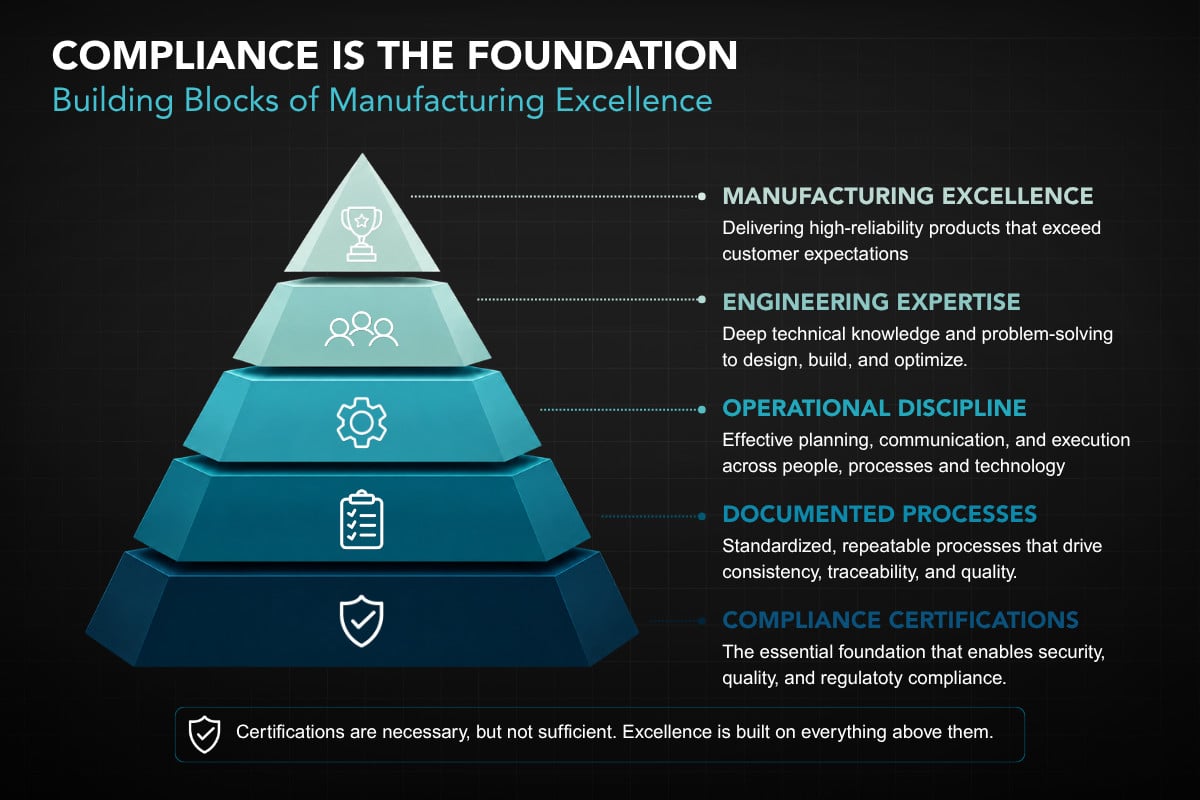
While certifications provide valuable indicators, supplier selection should not stop at verifying credentials.
OEMs should evaluate how effectively compliance requirements are integrated into day-to-day operations.
Several factors often provide a clearer picture of an EMS provider’s capabilities than certifications alone.
Evidence of Process Maturity
Ask suppliers to explain how quality systems operate in practice.
Strong providers can clearly describe:
- Risk management methodologies
- Corrective action workflows
- Audit programs
- Continuous improvement initiatives
- Performance metrics
The ability to demonstrate mature processes is often more important than simply holding a certificate.
Cybersecurity Readiness
For programs involving sensitive intellectual property or controlled data, cybersecurity should be evaluated as rigorously as manufacturing capability.
Questions may include:
- How is customer data protected?
- How are user privileges managed?
- What incident response procedures exist?
- How are third-party vendors evaluated?
- What cybersecurity audits are performed?
Traceability Capabilities
Regulated industries frequently require detailed product histories.
OEMs should verify traceability capabilities for:
- Components
- Materials
- Manufacturing processes
- Inspection records
- Test results
- Personnel qualifications
Comprehensive traceability supports both compliance and quality assurance objectives.
Supply Chain Controls
A strong EMS provider should demonstrate robust supplier management processes.
Evaluation areas include:
- Approved supplier programs
- Supplier qualification procedures
- Counterfeit component prevention
- Obsolescence management
- Incoming inspection practices
Supply chain performance directly influences product quality and delivery reliability.
Engineering and Technical Expertise
Certifications do not replace technical competence.
OEMs should assess:
- Manufacturing engineering resources
- Design for manufacturability (DFM) support
- Test engineering capabilities
- New product introduction processes
- Systems integration expertise
Technical depth often determines how effectively an EMS partner can support complex programs throughout the product lifecycle.
Regulatory Experience
Industry-specific experience matters.
An EMS provider supporting aerospace, defense, medical, and industrial markets should understand the documentation, validation, traceability, and audit expectations associated with those sectors.
Experience can significantly reduce onboarding time and lower program risk.
Looking Beyond Compliance?
Compliance certifications establish an important foundation—but they don’t tell the whole story.
Learn why lower-volume, higher-complexity manufacturing requires a fundamentally different approach to engineering, quality, and operations in our blog:
“Why Lower-Volume, Higher-Complexity EMS Manufacturing Requires a Completely Different Skill Set”
Evaluating the Complete EMS Partnership
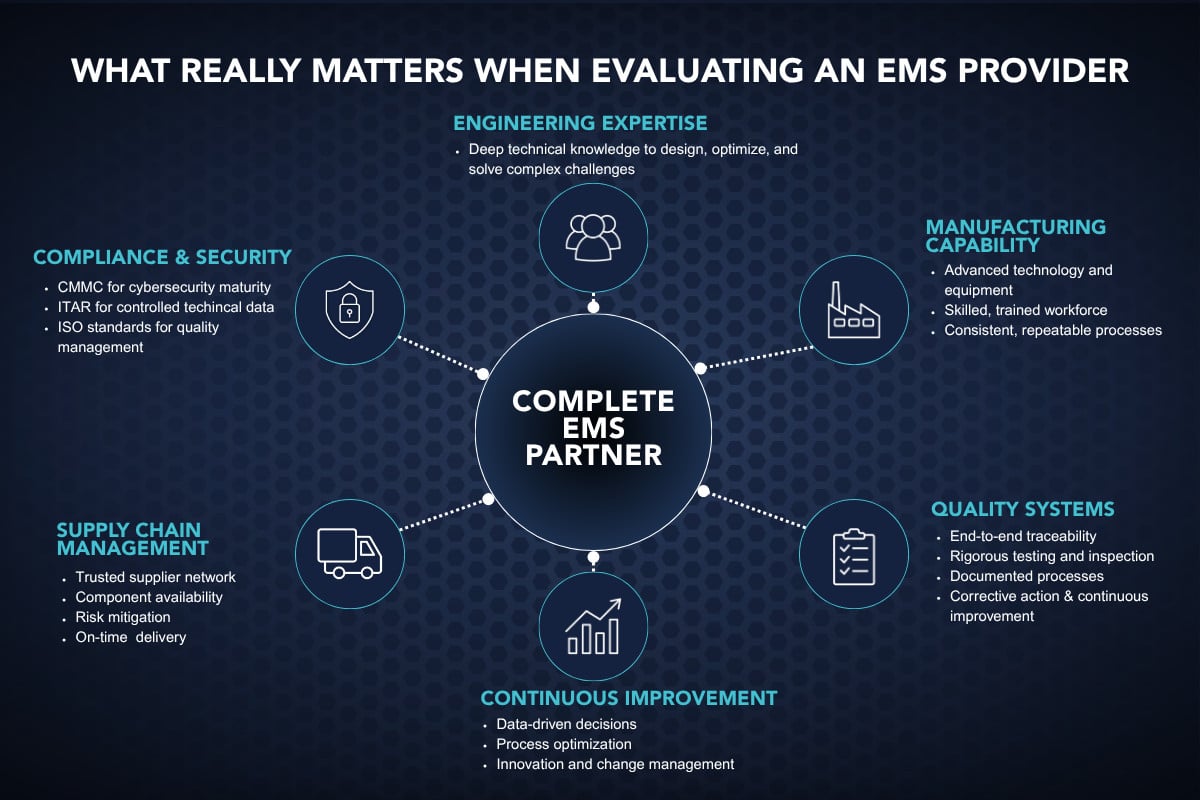
The most successful EMS relationships are built on a combination of compliance, technical expertise, operational excellence, and cultural alignment.
CMMC, ITAR, ISO 9001, AS9100, and ISO 13485 certifications provide valuable indicators that a manufacturer has invested in structured systems and controls. They help demonstrate a commitment to cybersecurity, quality, regulatory compliance, and continuous improvement.
However, certifications should be viewed as a starting point rather than the final qualification criterion.
OEMs should look beyond certificates to evaluate how effectively those requirements are embedded into daily operations, manufacturing processes, employee training, supply chain management, and customer support activities.
The strongest EMS partners combine compliance-driven discipline with engineering expertise, manufacturing excellence, and a proactive approach to risk management. For OEMs operating in highly regulated industries, this combination provides the foundation for secure, reliable, and scalable electronics manufacturing partnerships capable of supporting products throughout their entire lifecycle.
Need Help Navigating CMMC, ITAR, or ISO Requirements?
Whether you’re launching a defense program, transferring production, or evaluating a new manufacturing partner, we can help you understand the practical implications of compliance and determine the right manufacturing strategy for your program.