
BUILDING A BETTER EMS PROGRAM
EMS Partner Selection: 8 Risks OEMs Miss
Part 3 of 4
- Risk 1: The EMS Provider’s Business Model Doesn’t Fit the Program
- Risk 2: Manufacturing Capability Is Strong but Supply-Chain Management Is Reactive
- Risk 3: Engineering Change Control Is Weaker Than Engineering Capability
- Risk 4: Quality Practices Are Inconsistent on the Manufacturing Floor
- Risk 5: Test Engineering Capability Is Being Oversimplified
- Risk 6: Program Management Lacks the Authority to Resolve Issues
- Risk 7: Supplier Interfaces Add More Cost and Risk Than Expected
- Risk 8: Communication Breaks Down When Delivery Is Threatened
- Build Risk into Your EMS Partner Selection Process
- After Supplier Selection, NPI Puts the Plan to the Test
- Next in the Series
- Need Help Evaluating an EMS Partner?
EMS partner selection requires OEMs to look closely at how an electronics manufacturing services provider manages operational risk.
A typical EMS supplier presentation can make almost every qualified manufacturer look impressive. There are photos of advanced SMT lines. Certifications are displayed. Quality metrics, equipment capabilities, industries served, and references are presented. Management appears experienced, and the factory tour looks organized.
And if the supplier has made it to the final round, pricing is probably competitive.
So how does an OEM distinguish between several apparently capable manufacturers?
Alongside asking “Can they build the product?”, OEMs should ask “What could go wrong after we give them the product?”
That shift – from capability assessment to operational risk assessment—is especially important for complex electronics programs. Supply-chain discipline, engineering change control, quality practices, test engineering, and program management all influence what happens after a program is awarded.
The following eight risks can be easy to overlook during a conventional supplier evaluation – and can have significant consequences once production begins.
Risk 1: The EMS Provider’s Business Model Doesn’t Fit the Program
A manufacturer’s operating model shapes the programs it can support effectively. Production volume, product mix, engineering-change frequency, labor content, test complexity, and regulatory requirements all affect the fit.
An EMS provider optimized for long, repetitive production runs may have excellent equipment and quality systems but struggle with a lower-volume program that changes every few weeks.
Another supplier may excel at prototypes and new product introduction (NPI) but lack the planning systems, resources, or capacity needed for a major production ramp.
During EMS partner selection, OEMs should determine whether their program resembles the work the supplier is already organized to manage.
Questions to ask include:
- How many active part numbers does the facility manage?
- What are its typical production lot sizes?
- How frequently do programs experience engineering change orders (ECOs)?
- How does the organization transition programs from NPI to production?
- How much engineering support is available at the plant level?
The supplier’s day-to-day operating experience should align with the program’s demands across its expected lifecycle.
Risk 2: Manufacturing Capability Is Strong but Supply-Chain Management Is Reactive
A world-class production line depends on material availability. The EMS supply-chain organization therefore deserves the same scrutiny as manufacturing equipment.
Purchasing leverage is one consideration. OEMs should also examine how the supplier identifies material risk, communicates constraints, and coordinates decisions before a scheduled build is affected.
Ask how the organization manages:
- Long-lead components and changing lead times.
- Potential shortages and customer notification.
- Alternate components and required approvals.
- End-of-life notices and component obsolescence.
- Excess and obsolete inventory.
- Material commitments and customer responsibilities.
When does the supplier first communicate a potential shortage? What information accompanies that notification? Who owns the response?
Effective supply-chain management gives the OEM and EMS provider more time to evaluate options. Earlier visibility may allow alternate qualification, procurement action, or changes to production sequencing.
The timing of that visibility should be part of the supplier evaluation.
Risk 3: Engineering Change Control Is Weaker Than Engineering Capability
Engineering resources are an important qualification. OEMs should also understand how engineering changes move through the supplier’s manufacturing organization.
Consider a connector change. A single revision may affect:
- The bill of materials (BOM).
- Existing inventory.
- Open purchase orders.
- Cable drawings.
- Work instructions.
- Tooling and fixture interfaces.
- Test procedures.
- Inspection criteria.
- Production schedules.
- Finished-goods configuration.
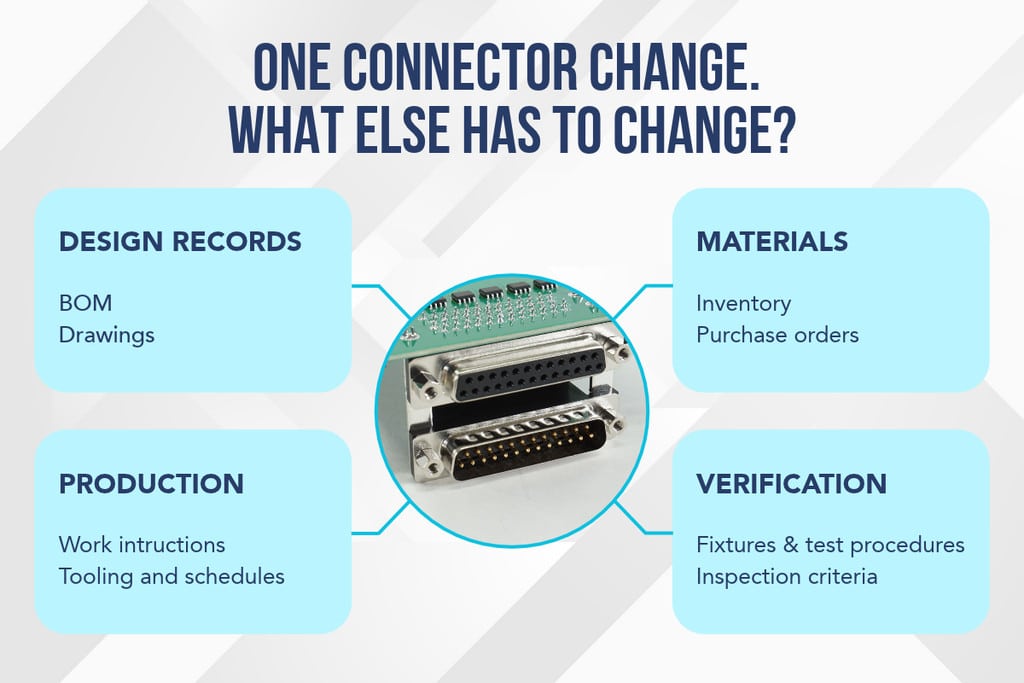
The drawing revision is one step in a broader implementation process. Each affected function must understand what changes, when the change takes effect, and how existing material and work in process will be handled.
During supplier evaluation, ask how the EMS provider releases revisions, controls their effective dates, and confirms that current information reaches every point of use.
The process should also address obsolete documentation and the disposition of material or assemblies built to earlier revisions.
For aerospace, defense, medical, and other high-reliability applications, this discipline is particularly important to configuration control and traceability.
Risk 4: Quality Practices Are Inconsistent on the Manufacturing Floor
Certifications such as ISO 9001, AS9100, and ISO 13485 provide important information about a supplier’s quality-management infrastructure. The factory visit offers an opportunity to examine how that infrastructure influences daily work.
Observe how operators access and use work instructions. Examine material identification and the segregation of nonconforming material. Ask how workmanship requirements are communicated and who has the authority to stop production.
Review corrective actions and determine whether the resulting changes reached the manufacturing process.
For printed circuit board assemblies (PCBAs), cable assemblies, and wire harnesses, small workmanship issues can have significant consequences:
- A crimp may appear acceptable while inadequate process control leaves a latent weakness.
- A soldering defect beneath an assembly may become expensive to locate and correct later.
- An incorrectly pinned connector may cause system-level failure even when the individual components meet requirements.
The evaluation should establish how the supplier prevents defects, verifies process performance, and responds when a process falls outside requirements.
Strong quality practices bring prevention into the work itself.
Risk 5: Test Engineering Capability Is Being Oversimplified
A supplier’s ability to perform functional testing is only the starting point for evaluating test capability.
OEMs should understand how the EMS provider develops, implements, and supports the test process throughout production.
Can the organization support:
- Fixture design.
- Electrical and functional testing.
- Programming and firmware verification.
- Test-data collection.
- Troubleshooting.
- Failure analysis.
- Maintenance of test equipment.
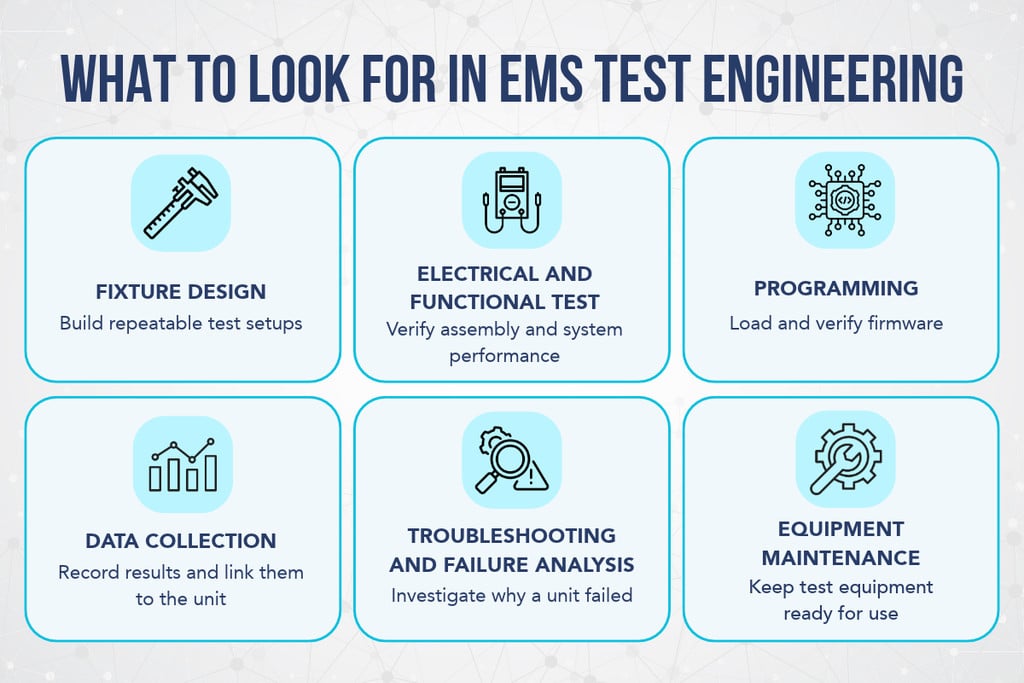
For integrated products, testing may need to verify interactions among PCBAs, cable assemblies, power supplies, mechanical devices, and firmware.
That creates requirements for test coverage, reliable connections, repeatable setups, and clear acceptance criteria. It also creates responsibilities for resolving failures and maintaining the test system as the product changes.
During EMS partner selection, establish who owns test development, what the OEM must provide, and how changes to fixtures, software, or procedures will be controlled.
Gaps in test-development capability can remain hidden until after program award, when they begin affecting production readiness and delivery schedules.
Risk 6: Program Management Lacks the Authority to Resolve Issues
Complex electronics programs depend on coordination across purchasing, engineering, quality, manufacturing, planning, and test engineering.
Each function owns part of the work. Program management must connect those activities and drive decisions when their priorities intersect.
The program manager needs the authority and organizational support to escalate shortages, obtain engineering responses, coordinate quality actions, and bring the appropriate people together when delivery is at risk.
During supplier evaluation, meet the people who will manage the program after award.
Ask:
- What is the internal and customer meeting cadence?
- What information will the customer receive?
- How are open actions assigned and tracked?
- How are schedule risks escalated?
- Who resolves issues that cross functional boundaries?
These questions are especially important during NPI, when material readiness, documentation, tooling, test development, and production planning must advance together.
Evaluate whether program management can move the organization toward resolution as well as communicate status.
Risk 7: Supplier Interfaces Add More Cost and Risk Than Expected
For products containing PCBAs, cable assemblies, wire harnesses, mechanical components, and final integration, the choice of manufacturing partners affects how the program will be coordinated.
Specialized suppliers may offer strong economics and technical expertise. Each supplier interface also creates requirements for communication, configuration control, scheduling, and problem resolution.
Consider a final system that fails functional test. The cause may involve:
- The PCBA.
- A cable or connector.
- Firmware.
- Mechanical interference.
- Assembly errors.
- The test fixture.
When several suppliers are involved, establishing ownership can take longer than correcting the underlying issue.
For some products, consolidating manufacturing disciplines within a vertically integrated EMS organization can simplify accountability and shorten the path to resolution. Other programs benefit from a network of specialist suppliers.
The evaluation should account for the coordination each approach requires. Identify who owns final integration, how technical issues will be investigated, and how suppliers will share information when responsibility is unclear.
Those interfaces carry costs that may be absent from individual piece-price quotations.
Risk 8: Communication Breaks Down When Delivery Is Threatened
Supplier communication is usually strong during the sales process. OEMs should examine how it operates when a program encounters difficulty.
Does the EMS provider surface problems early? Does it explain the potential schedule impact? Does it present recommended actions and identify the decisions the customer needs to make?
Ask how the supplier has handled shortages, quality issues, or engineering delays on comparable programs. Look for a defined escalation process and clear ownership of follow-up actions.
Early communication expands the time available to respond.
A component shortage identified eight weeks before production may leave time to qualify an alternate, expedite material, or resequence a build. The same shortage identified two days before production may leave few practical options.
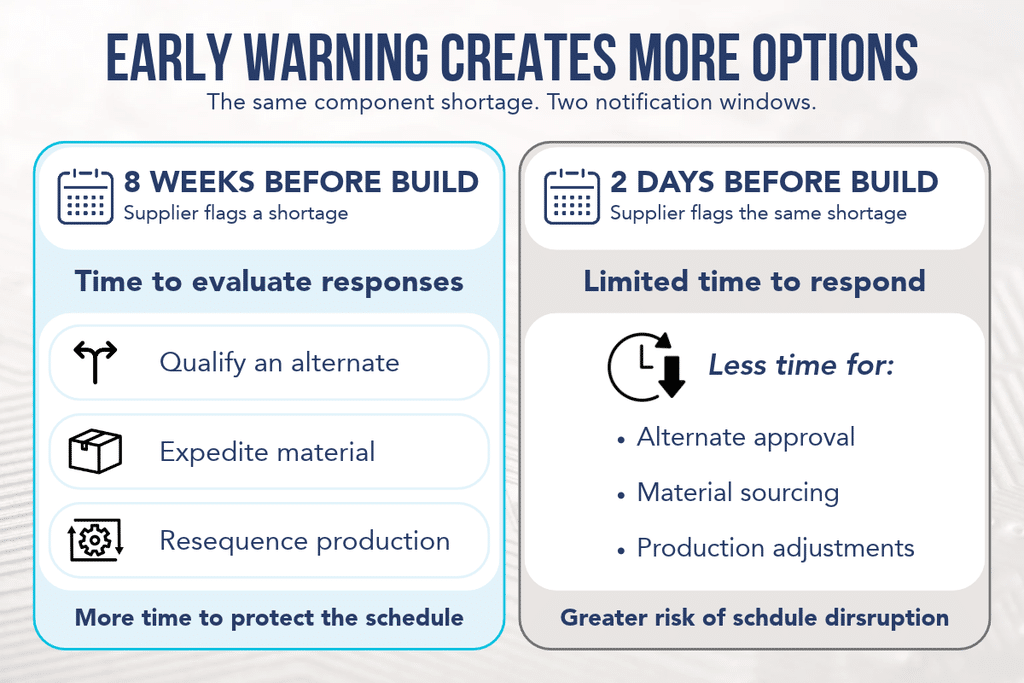
The timing and quality of communication should therefore carry weight in EMS partner selection. An OEM needs visibility early enough to participate in decisions that affect its program.
Build Risk into Your EMS Partner Selection Process
A useful EMS supplier evaluation gives decision-makers a clear view of the risks most relevant to their program.
A concise framework can organize the discussion across seven categories. Weight each category according to the product’s complexity, production requirements, and business consequences.
Commercial Risk
Evaluate price competitiveness, payment terms, material liabilities, and inventory assumptions. Establish which costs and obligations sit outside the quoted assembly price.
Technical Risk
Assess process capability, engineering depth, manufacturability, and test-development resources against the product’s actual requirements.
Supply-Chain Risk
Review long-lead exposure, sourcing discipline, component obsolescence, and the processes used to identify and resolve shortages.
Quality Risk
Examine process controls, traceability, workmanship requirements, and corrective-action effectiveness.
Operational Risk
Evaluate capacity, production planning, labor flexibility, and the supplier’s ability to manage changes in demand.
Program Risk
Assess communication, reporting, escalation, and coordination across the functions supporting the customer program.
Strategic Risk
Consider financial stability, geographic footprint, scalability, and alignment with the product’s expected lifecycle.
This approach makes the selection decision easier to explain and defend. Price remains part of the assessment, alongside the operational requirements and risks that will influence total program performance.
After Supplier Selection, NPI Puts the Plan to the Test
Suppose the OEM has prepared a clear RFQ, evaluated total cost, examined supplier risk, and selected an EMS partner suited to the program.
The purchase order is issued. The next challenge is execution.
During new product introduction, drawings, forecasts, quotations, and manufacturing plans must become a repeatable production process. Material readiness, revision control, tooling, test development, and cross-functional coordination all come together.
This is where small gaps can combine into shortages, rework, and schedule delays.
The discipline used during EMS partner selection establishes the foundation. NPI tests how effectively the OEM and manufacturing partner can put that foundation to work.
Next in the Series
Part 4: Where Electronics NPI Programs Go Wrong—and How to Prevent It
The final article follows the program onto the manufacturing floor and examines the failure points that separate a successful transition from engineering into production from one dominated by rework, shortages, and recovery meetings.
Need Help Evaluating an EMS Partner?
If you’re comparing manufacturing partners, we’d be happy to discuss your program, review your manufacturing requirements, and help you identify the factors that have the greatest impact on long-term cost, quality, and delivery performance.