
BUILDING A BETTER EMS PROGRAM
The Work OEMs Should Do Before Sending an EMS RFQ
Part 2 of 4
- BUILDING A BETTER EMS PROGRAM
- Part 2 of 4
- An RFQ Should Define the Manufacturing Problem
- Start With Configuration Control
- Look at the BOM Before Your Suppliers Do
- Define the Real Volume Profile
- Don't Treat Test as a Footnote
- Decide What You Actually Want the EMS Provider to Own
- Let the Supplier Challenge the Package
- Define the Evaluation Criteria Before You See the Price
- Give Suppliers the Same Question
- A Better RFQ Sets Up a Better Partnership
- Next in the Series
- Need Help Evaluating an EMS Partner?
The quality of an EMS supplier decision depends heavily on something that happens before supplier evaluation begins:
The quality of the RFQ itself.
OEMs understandably want to move quickly.
Engineering reaches an important milestone. Procurement is asked to obtain manufacturing quotations. Candidate suppliers are identified. Drawings, BOMs and forecasts are assembled and sent out.
Then the questions begin.
Which revision should we quote?
Are substitutions allowed?
Who provides the test fixture?
Is this annual volume or a single build?
Is the cable drawing released?
Are these parts customer-supplied?
Does the assembly require serialization?
What inspection standard applies?
What is the expected production ramp?
Meanwhile, different suppliers make different assumptions so they can meet the quotation deadline.
Several weeks later, the OEM receives four polished proposals that appear comparable.
They may not be comparable at all.
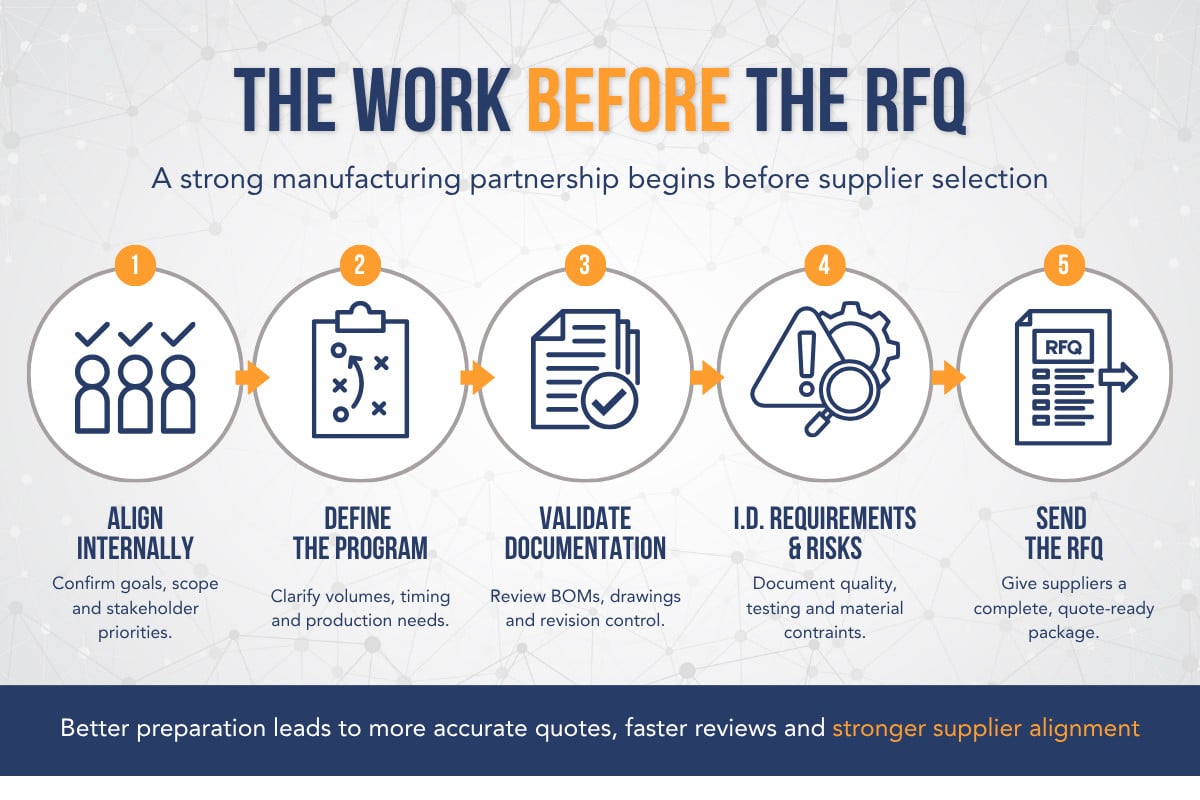
The RFQ is more than simply a pricing event. It’s the beginning of manufacturing risk management.
The better the information going into the sourcing process, the better the decision coming out.
An RFQ Should Define the Manufacturing Problem
The purpose of an RFQ is not simply to ask:
How much will you charge to build this?
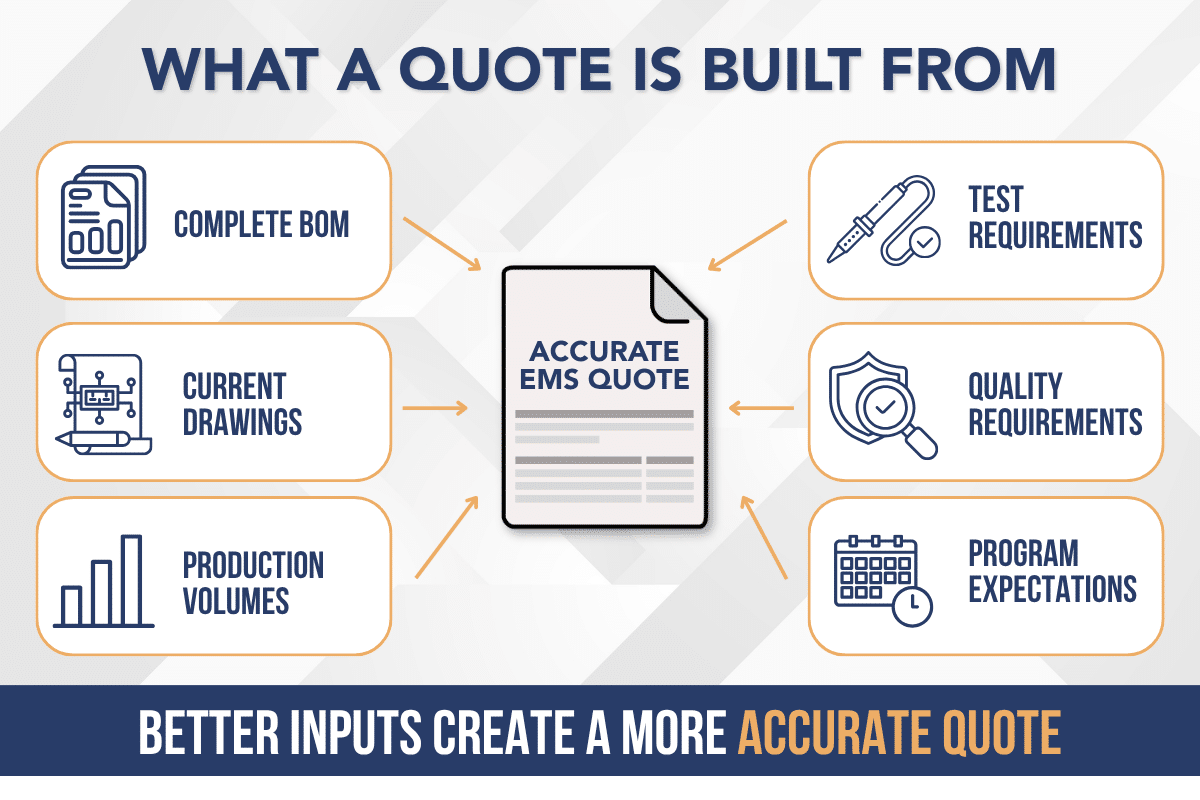
A good RFQ should allow the EMS provider to understand:
- what is being built,
- how mature the design is,
- how it will be tested,
- what quality requirements apply,
- how quickly production may change,
- what volumes are expected,
- what risks already exist,
- and what the OEM expects the EMS partner to own.
That allows suppliers to propose an operating solution rather than simply calculate material plus labor.
Start With Configuration Control
One of the most basic questions in manufacturing is:
What revision are we building?
For an RFQ, the equivalent question is:
What revision are we quoting?
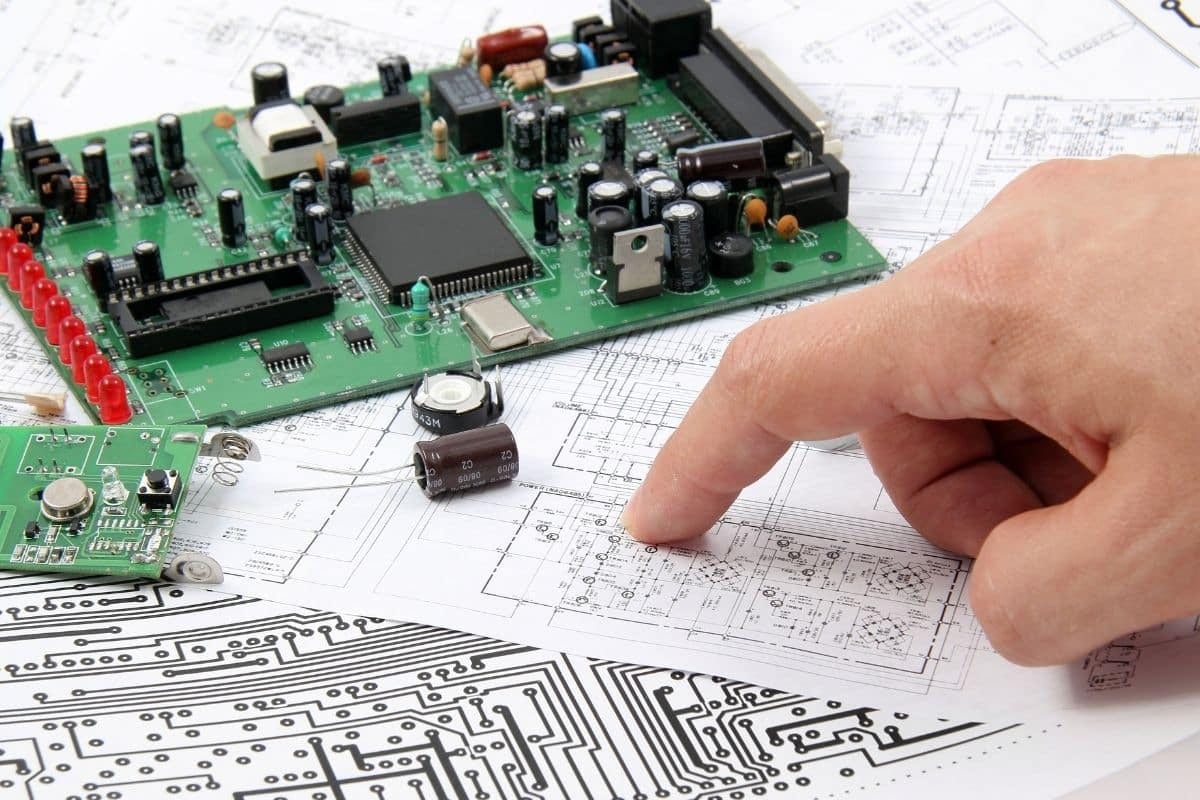
The OEM should identify the configuration baseline being released.
That may include:
- BOM revision,
- PCBA assembly drawing,
- fabrication data,
- schematics,
- Gerber or intelligent design files,
- cable drawings,
- wire lists,
- mechanical drawings,
- software revision,
- test specification,
- workmanship standards,
- packaging requirements,
- and applicable customer specifications.
The program may still be changing.
That is normal during NPI.
But suppliers need a point-in-time baseline from which assumptions and changes can be managed.
Without one, quotation differences can be meaningless.
Look at the BOM Before Your Suppliers Do
An experienced EMS provider is going to analyze the BOM.
The OEM should do the same first.
Look for:
- obsolete components,
- end-of-life notices,
- very long lead times,
- single-source items,
- custom components,
- programmed devices,
- unclear manufacturer part numbers,
- sole-approved manufacturers,
- parts with unusual minimum order quantities,
- and components subject to special traceability or sourcing requirements.
The goal is not necessarily to resolve everything before requesting a quote.
The goal is to know where the risk is.
If one supplier quotes the exact approved component while another quietly assumes a lower-cost substitute, their prices are not truly comparable.
An RFQ should make alternate-component rules explicit.
Define the Real Volume Profile
Annual usage is useful.
It is not enough.
Consider two programs that both consume 240 units annually.
Program A requires approximately 20 units every month.
Program B requires 120 units in March and another 120 in September.
Those are completely different manufacturing and material-planning problems.
The EMS provider should understand:
- prototype quantities,
- pre-production quantities,
- production ramp,
- expected annual volume,
- typical lot size,
- forecast variability,
- seasonality,
- upside scenarios,
- expected product life,
- and whether demand is forecast-driven or purchase-order driven.
That information affects material strategy, labor planning, tooling and capacity.
It can also determine which EMS operating model is best suited to the program.
Don’t Treat Test as a Footnote
Testing is one of the most common areas where RFQ assumptions turn into NPI delays.
“Functional test required” is not a test strategy.
The RFQ should clarify as much as possible:
Who owns test development?
Does equipment already exist?
Who designs fixtures?
Who writes software?
What interfaces are involved?
Are limits established?
Is a golden unit available?
Does the OEM require test-data retention?
What failure diagnostics are expected?
Are there environmental, hipot, continuity, leakage, burn-in or other specialized tests?
For integrated electromechanical products, test can become even more complex because the PCBAs, cable assemblies, firmware, power systems and mechanical interfaces all converge at final assembly.
If test equipment is not ready when product is ready, manufacturing stops even though every assembly operation may have been completed successfully.
That is why test readiness should begin at RFQ and NPI planning—not at the end of the production line.
Decide What You Actually Want the EMS Provider to Own
Different OEMs use EMS partners differently.
One OEM may provide complete documentation and want a tightly controlled build-to-print relationship.
Another may expect significant support with:
- design-for-manufacturability,
- supply-chain management,
- component engineering,
- tooling,
- test development,
- cable and harness manufacturing,
- mechanical sourcing,
- box build,
- system integration,
- product configuration,
- and lifecycle management.

Those expectations should be visible in the sourcing process.
Otherwise, the OEM may award the program to the supplier with the best answer to a question it never intended to ask.
A company optimized around repetitive PCBA production may be highly efficient but poorly suited to an engineering-intensive system requiring frequent changes and cable, harness and electromechanical integration.
Likewise, a high-complexity EMS provider may not be the optimal answer for a simple commodity assembly produced in enormous volumes.
The objective is not to find the theoretically “best EMS company.”
It is to find the best fit for the program.
Let the Supplier Challenge the Package
One of the most useful things an OEM can do during sourcing is invite the supplier to identify problems.
Ask:
What concerns you about this package?
Then listen carefully.
A capable manufacturing organization may identify:
- component risks,
- inaccessible test points,
- unusual PCB fabrication requirements,
- manufacturability concerns,
- cable dimensions that are difficult to reproduce,
- tolerance stackups,
- assembly-sequence problems,
- ambiguous workmanship requirements,
- tooling issues,
- unrealistic production timing,
- or gaps in test coverage.
An OEM should not automatically penalize the supplier that asks the most questions.
Sometimes the supplier identifying the most risk is the supplier that understands the product best.
A quotation containing no questions for a complex new product can be more concerning than one containing twenty.
Define the Evaluation Criteria Before You See the Price
Human nature matters in sourcing.
Once the price column appears, it tends to dominate the conversation.
A better practice is to establish the supplier-selection framework before proposals arrive.
Criteria might include:
- commercial competitiveness,
- technical capability,
- manufacturing-process fit,
- quality performance,
- supply-chain capability,
- engineering responsiveness,
- test capabilities,
- program management,
- regulatory certifications,
- capacity,
- geographic strategy,
- financial stability,
- and ability to support the product throughout its lifecycle.
The categories do not need equal weighting.
Price may legitimately be one of the largest factors.
But the organization has consciously decided what matters before knowing which supplier wins each category.
Give Suppliers the Same Question
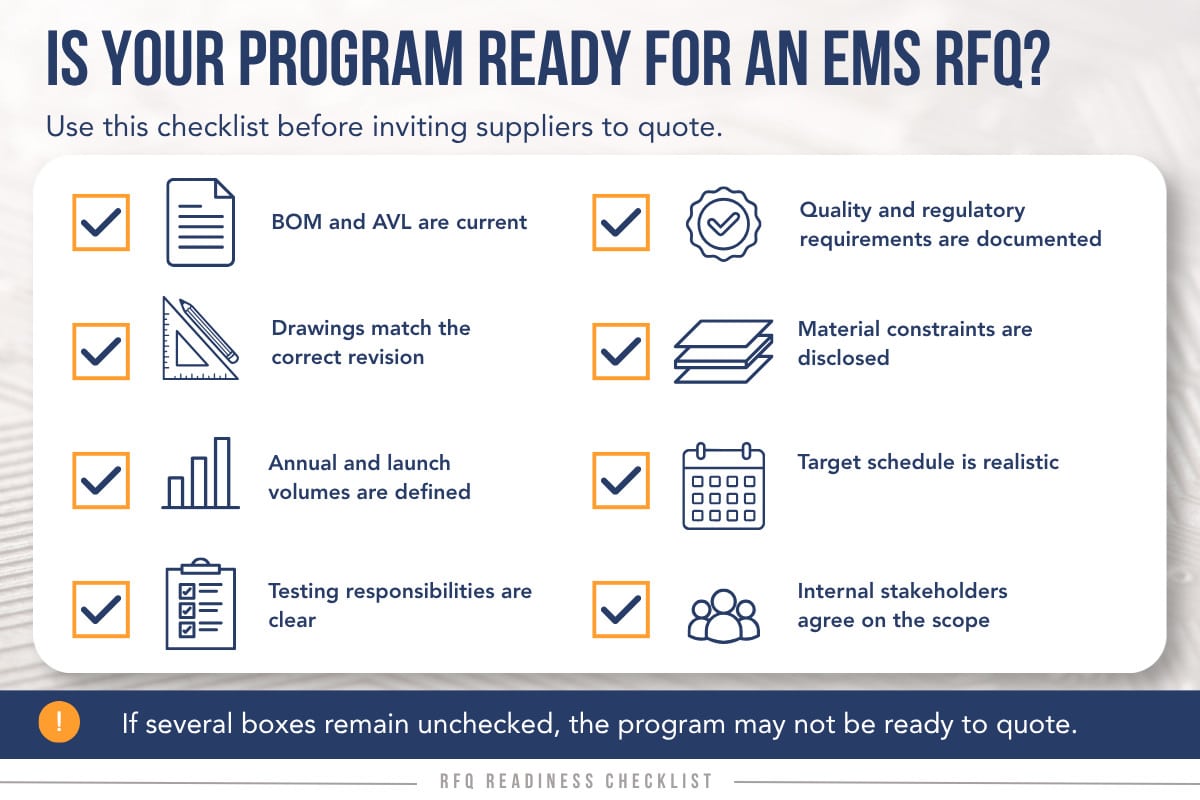
At its simplest, good RFQ preparation is about creating a common basis of comparison.
If one EMS supplier assumes turnkey material, another assumes customer-supplied material and a third assumes substitutions, the OEM has three prices for three different programs.
If one supplier includes functional-test development while another assumes the OEM will deliver working fixtures, their NRE numbers tell you very little.
RFQ clarity removes noise from supplier selection.
And that helps the OEM distinguish between a supplier that is simply inexpensive and one that is genuinely lower-risk.
A Better RFQ Sets Up a Better Partnership
Good pre-RFQ discipline has another benefit.
It changes the early relationship between the OEM and EMS provider.
Instead of starting with:
Give us your lowest price.
The conversation becomes:
Here is the product, here is the operating environment, here is what we expect, and here are the risks we already see. Tell us how you would manufacture it successfully.
That is a much more valuable question.
But once the RFQ has been properly structured and several qualified suppliers respond, the OEM still faces a difficult decision.
How do you distinguish between companies that all have good equipment, recognized certifications and competitive pricing?
You evaluate what is likely to go wrong.
Next in the Series
Part 3: The Risks OEMs Miss When Selecting an EMS Partner
The next article moves beyond the quote and examines the operational risks that often remain invisible until after a program has been awarded.
Need Help Evaluating an EMS Partner?
If you’re comparing manufacturing partners, we’d be happy to discuss your program, review your manufacturing requirements, and help you identify the factors that have the greatest impact on long-term cost, quality, and delivery performance.