
Box Build Assembly Explained: From Circuit Card Assembly + Cable Assembly to Fully Integrated Systems
- What Is Electronic Box Build Assembly?
- The Foundation: Circuit Card Assembly
- Connecting the System: Cable and Wire Harness Assembly
- Mechanical Integration Through Custom Fabricated Sheet Metal
- Systems Integration: Bringing Everything Together
- Benefits of Consolidating Higher-Level Assembly with One EMS Provider
- How to Evaluate an EMS Provider for Box Build Assembly Services
- Evaluating EMS Providers?
- Conclusion
- Evaluating a Box Build Assembly Program?
As electronic products become increasingly complex, manufacturers are looking beyond simple printed circuit board assembly and seeking partners capable of delivering fully integrated systems. This has led to growing demand for electronic box build assembly services, where multiple manufacturing disciplines are combined to create complete, tested, and deployment-ready products.
Box build assembly—sometimes referred to as systems integration, higher-level assembly, or electro-mechanical assembly—is the process of integrating circuit card assemblies, cable and wire harnesses, mechanical enclosures, fabricated components, power systems, and software-configured hardware into a finished product. Rather than receiving dozens of individual components from multiple suppliers and managing final assembly internally, OEMs can leverage an Electronics Manufacturing Services (EMS) provider to manage the entire build process from procurement through final system integration.
Understanding how these capabilities come together is essential for organizations developing aerospace, defense, medical, industrial, semiconductor equipment, communications, and other high-reliability electronic products.
What Is Electronic Box Build Assembly?
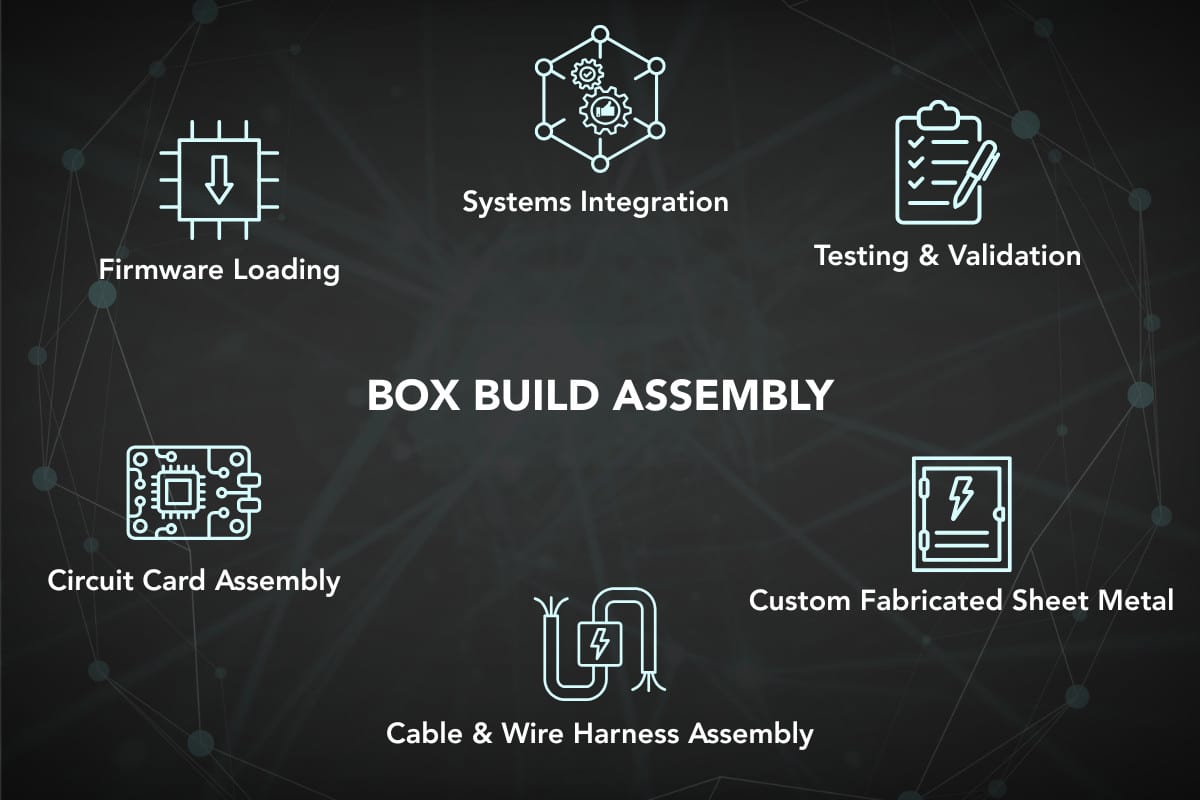
Electronic box build assembly encompasses all manufacturing activities required to transform individual electronic and mechanical components into a complete functional system.
While PCB assembly focuses on populating components onto a printed circuit board, box build assembly takes the process significantly further. A typical box build program may include:
- Printed circuit board assembly (PCBA)
- Cable and wire harness manufacturing
- Mechanical assembly
- Custom sheet metal integration
- Power distribution assembly
- Installation of displays, switches, and user interfaces
- Electromechanical integration
- Firmware loading and configuration
- Functional testing
- System-level validation
- Packaging and logistics
The end result is a fully assembled product that can be installed, deployed, or shipped directly to the end customer.
Examples of products commonly manufactured through box build assembly include:
- Industrial control systems
- Aerospace avionics equipment
- Defense electronics
- Medical diagnostic devices
- Semiconductor manufacturing equipment
- Telecommunications hardware
- Test and measurement systems
- Power distribution units
- Rack-mounted electronic systems
- Embedded computing platforms
The complexity of these products requires expertise across multiple manufacturing disciplines that must work together seamlessly.
The Foundation: Circuit Card Assembly
Every electronic system begins with circuit card assemblies (CCAs), commonly referred to as PCB assemblies.
Circuit card assembly involves mounting electronic components onto printed circuit boards using automated Surface Mount Technology (SMT) and through-hole assembly processes. These assemblies typically contain:
- Microprocessors
- Memory devices
- Power management circuits
- Communication interfaces
- Sensors
- Connectors
- Analog and digital circuitry
Within a box build program, multiple PCB assemblies may be integrated into a single product. Some systems contain only one circuit board, while others may contain dozens of interconnected assemblies.
Quality at the PCB assembly level is critical because failures introduced during board assembly often propagate throughout the entire system. High-reliability EMS providers therefore implement robust manufacturing controls, including:
- Automated optical inspection (AOI)
- X-ray inspection
- Solder process control
- IPC-certified workmanship standards
- In-circuit testing
- Functional testing
- Statistical process monitoring
The circuit card assemblies become the electronic foundation upon which the rest of the system is built.
Connecting the System: Cable and Wire Harness Assembly
While PCB assemblies perform the electronic functions, cable and wire harness assemblies provide the physical connections that enable the system to operate as an integrated whole.
Wire harnesses route power and signals between subsystems, connecting:
- Circuit boards
- Displays
- Power supplies
- Sensors
- Motors
- Switches
- Connectors
- External interfaces
In complex systems, harness design and manufacturing can be as critical as PCB assembly itself. Poorly designed or improperly manufactured harnesses can lead to intermittent failures, signal integrity issues, reliability concerns, and field service problems.
High-quality cable and harness manufacturing requires:
- Controlled wire processing
- Precision stripping and termination
- Crimp validation
- Pull-force testing
- Continuity verification
- IPC/WHMA-A-620 compliance
- Traceability of materials and processes
For aerospace, defense, medical, and industrial applications, wire harnesses must often withstand vibration, temperature extremes, mechanical stress, and long operational lifecycles.
When circuit card assembly and harness manufacturing are performed under the same EMS organization, engineering coordination improves significantly, reducing integration risk and accelerating product launches.
Mechanical Integration Through Custom Fabricated Sheet Metal
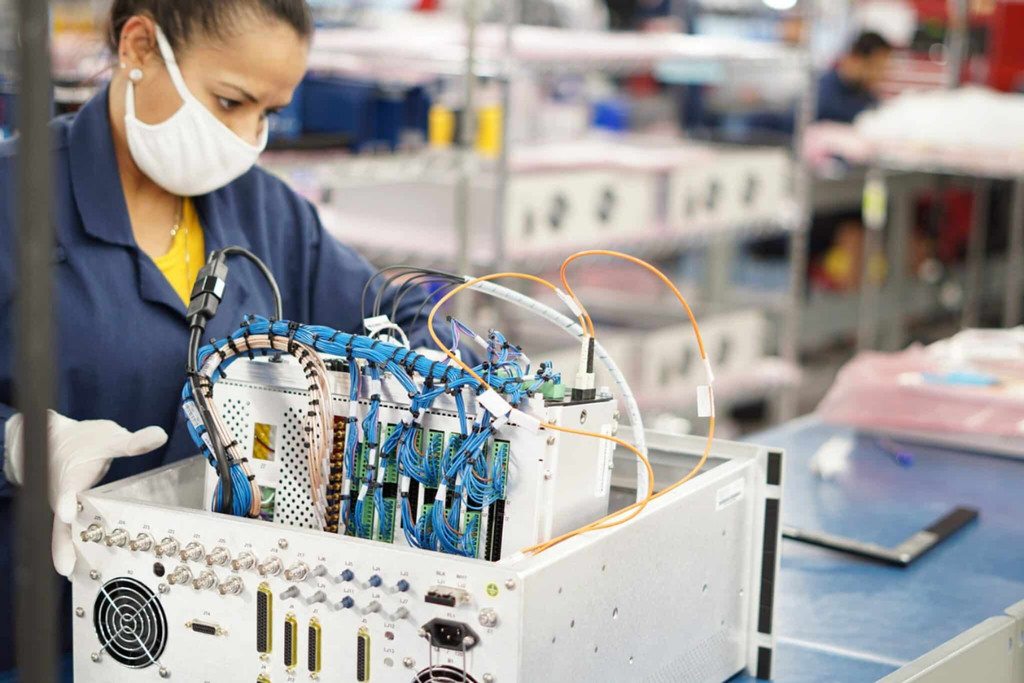
Electronic systems require mechanical structures that protect internal components, support assembly, and enable deployment in real-world environments.
Custom fabricated sheet metal components often form the structural backbone of a box build assembly. These components may include:
- Enclosures
- Chassis
- Mounting brackets
- Equipment racks
- Covers and panels
- Heat management structures
- EMI shielding assemblies
The quality and precision of fabricated components directly impact final assembly efficiency and product performance.
Successful box build programs require close coordination between electrical and mechanical design requirements. Factors such as connector placement, cable routing, airflow management, thermal performance, serviceability, and manufacturing tolerances must be carefully managed.
An EMS provider with established relationships and expertise in custom fabrication sourcing can help customers optimize:
- Cost
- Lead times
- Manufacturability
- Mechanical fit
- Product reliability
Managing fabricated components through the same supply chain organization responsible for electronics manufacturing also simplifies procurement and inventory management while reducing schedule risk.
Systems Integration: Bringing Everything Together
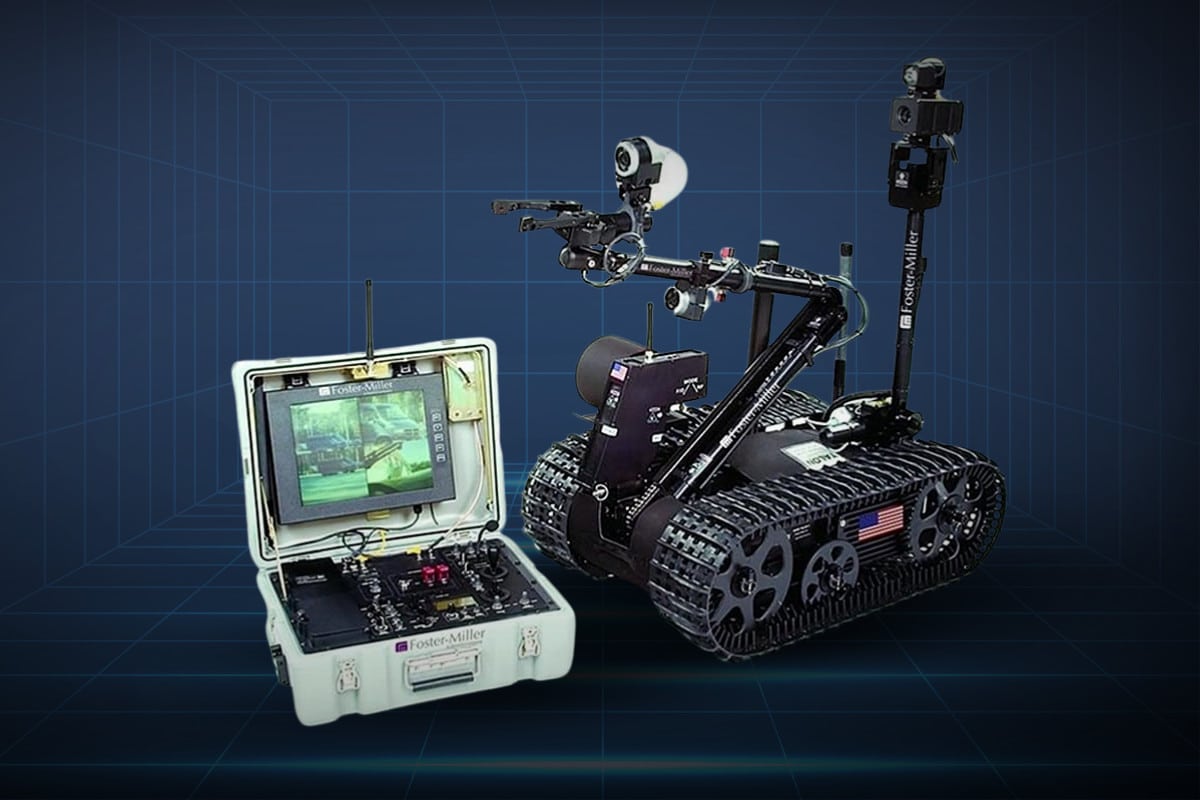
Systems integration is where individual components become a complete functional product.
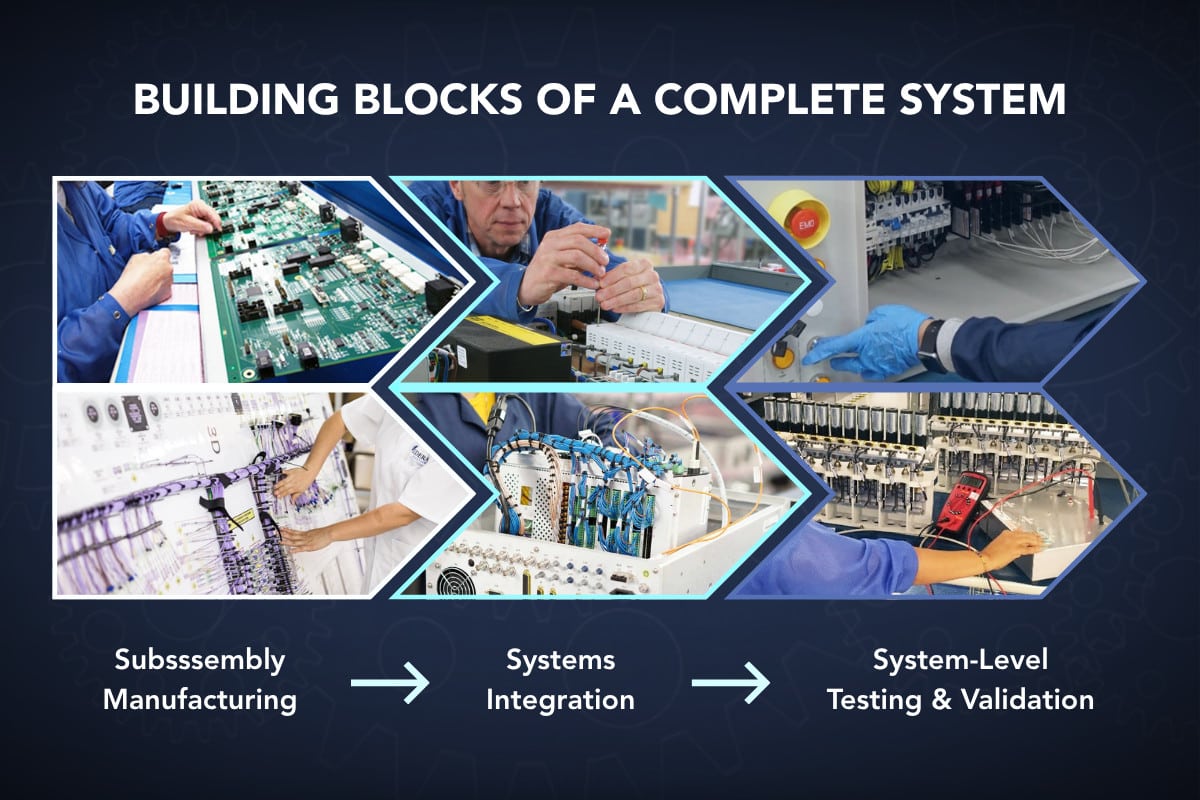
This phase combines circuit card assemblies, cable assemblies and wire harnesses, fabricated mechanical components, purchased hardware, and software-configured subsystems into a finished assembly.
Typical systems integration activities include:
- Mechanical assembly
- Cable and harness routing and securing
- Connector installation
- Power distribution integration
- Subassembly installation
- Firmware loading
- Software configuration
- Calibration
- Functional verification
- System-level testing
Unlike individual component manufacturing, systems integration requires technicians and engineers to understand how all subsystems interact within the final product.
For example, a semiconductor equipment controller may contain multiple PCB assemblies, dozens of cable harnesses, custom sheet metal enclosures, power supplies, cooling systems, displays, and operator interfaces. Each element must be assembled correctly and verified through comprehensive testing before shipment.
The ability to manage these interactions effectively often distinguishes elite EMS providers from those focused solely on PCB assembly.
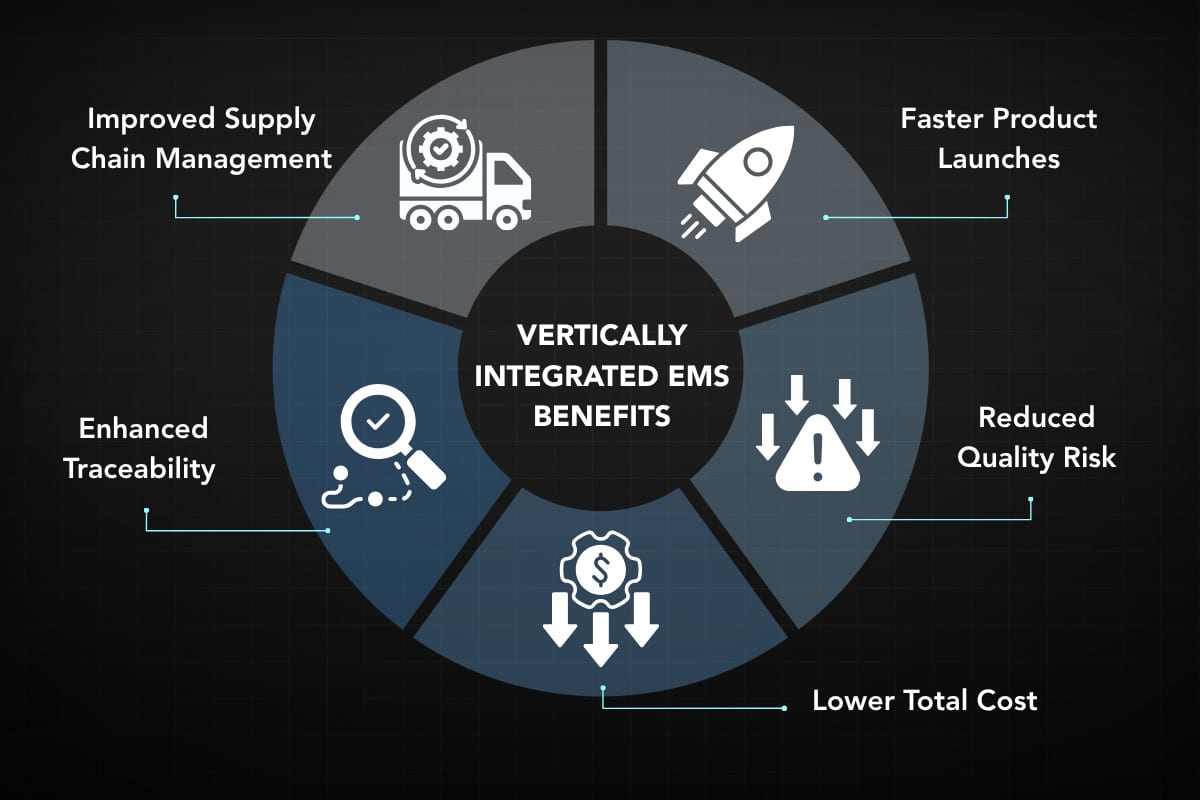
Benefits of Consolidating Higher-Level Assembly with One EMS Provider
Many OEMs historically sourced PCB assemblies, cables and harnesses, mechanical components, and final assembly services from separate suppliers. While this approach may appear flexible, it often creates operational challenges.
Consolidating higher-level assembly under a single EMS provider offers several advantages.
Improved Supply Chain Management
A single manufacturing partner can coordinate procurement across all commodities, reducing complexity and minimizing supplier management requirements.
Faster Product Launches
Integrated engineering and manufacturing teams can identify and resolve issues earlier in the product lifecycle, reducing delays during prototype and production phases.
Reduced Quality Risk
Ownership of the complete assembly process improves accountability and reduces opportunities for defects to be introduced during handoffs between suppliers.
Lower Total Cost
Although individual component pricing may not always be lowest through a single supplier, overall program costs are often reduced through improved efficiency, lower logistics costs, fewer quality escapes, and the elimination of margin stack-up.
Enhanced Traceability
Vertically integrated EMS providers can maintain complete traceability from components and across circuit boards, cables, fabricated components, and final assemblies, supporting regulatory and customer requirements.
How to Evaluate an EMS Provider for Box Build Assembly Services
Not all EMS providers possess the infrastructure, engineering expertise, and operational maturity required for complex box build programs.
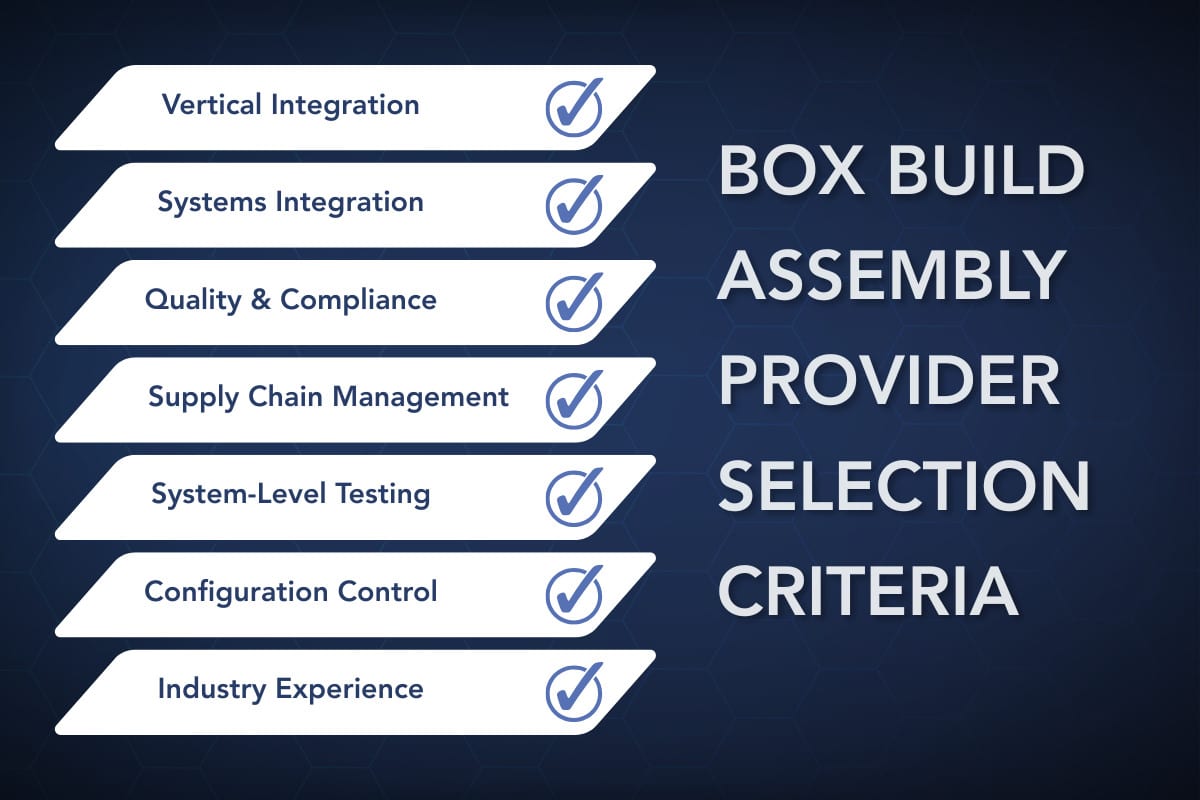
When evaluating potential manufacturing partners, customers should consider several key criteria.
Vertical Integration Capabilities
Look for providers that can support multiple manufacturing disciplines internally, including:
- PCB assembly
- Cable assembly and wire harness manufacturing
- Electromechanical assembly
- Testing
- Systems integration
The more capabilities that exist within a coordinated manufacturing ecosystem, the lower the overall program risk and cost.
Engineering Expertise
Successful box build programs require strong collaboration between design, manufacturing, quality, and supply chain teams.
Evaluate whether the EMS provider offers:
- Design for Manufacturability (DFM)
- Design for Assembly (DFA)
- Test engineering
- Process engineering
- New Product Introduction (NPI) support
Engineering engagement early in the product lifecycle often produces substantial cost and schedule benefits.
Quality Management Systems
High-reliability products demand rigorous quality controls.
Assess certifications and compliance programs such as:
- AS9100
- ISO 9001
- ISO 13485
- IPC-A-610
- IPC/WHMA-A-620
- J-STD-001
Also evaluate corrective action systems, process controls, audit performance, and continuous improvement programs.
Supply Chain Strength
Global component shortages and long lead times have elevated supply chain management into a strategic differentiator.
Key evaluation areas include:
- Supplier management processes
- Material planning capabilities
- Obsolescence management
- Global sourcing expertise
- Inventory strategies
- Risk mitigation programs
Testing and Validation Capabilities
Comprehensive testing reduces field failures and improves product reliability.
Determine whether the EMS provider can support:
- Functional testing
- System-level testing
- Environmental testing
- Burn-in testing
- Customer-specific validation requirements
Scalability
A manufacturing partner should be capable of supporting products throughout their lifecycle, from prototype through full-rate production.
Evaluate:
- Production capacity
- Facility footprint
- Workforce capabilities
- Geographic manufacturing options
- Growth plans
Industry Experience
Industry-specific expertise can significantly reduce risk.
Providers serving aerospace, defense, medical, semiconductor equipment, and industrial markets typically possess the quality systems, process controls, and technical capabilities required for complex higher-level assemblies.
Evaluating EMS Providers?
For a broader look at EMS supplier evaluation, read our guide:
“Selecting an Electronics Contract Manufacturer: 7 Critical Factors OEMs Must Consider.”
Explore additional considerations related to engineering support, quality systems, supply chain management, and long-term manufacturing partnership strategy.
Conclusion
Electronic box build assembly represents the convergence of multiple manufacturing disciplines into a single, integrated production process. Circuit card assembly, cable assembly and wire harness manufacturing, custom fabricated sheet metal sourcing, and systems integration all play essential roles in transforming individual components into fully functional products.
As product complexity continues to increase, OEMs are increasingly seeking EMS partners capable of managing complete higher-level assembly programs. The most successful manufacturing relationships are built on strong engineering support, robust quality systems, integrated supply chain management, and proven systems integration expertise.
When evaluating an EMS provider, customers should look beyond basic PCB assembly capabilities and assess the organization’s ability to deliver complete, tested, and scalable manufacturing solutions. A capable box build partner can reduce supply chain complexity, accelerate product launches, improve quality, and provide a strategic advantage throughout the product lifecycle.
Evaluating a Box Build Assembly Program?
Not every EMS provider is equipped to manage PCB assembly, cable and wire harness assembly, fabricated enclosures, firmware loading, and system-level testing under a single supplier relationship.
We can help you assess the manufacturing, supply chain, and systems integration requirements behind your next program.